



People · sourced chart

Heinrich Hertz
Physicist and philosopher · Germany · 1857–1894
Birth date sourced. Birth time unknown.The Moon remained in Aquarius throughout that civil day. Mars crossed from Pisces into Aries during that day, so its sign is left open. Everything below uses only what the complete civil day settles.
The day, read honestly
Tightest of all, the Sun holds a sextile to Pluto at 0.1° — close enough to weld identity to depth. Sextiles are read as standing invitations — productive exactly as often as they are accepted.
Positions at 12:00 civil time in Hamburg—a reference instant, not a birth time. No houses, rising sign, angles, or sect were computed.
Where the Sun actually stood
At the noon reference the Sun sits 3.8° into Pisces — the first decan, which the old scheme hands to Jupiter. Same sign, different decan, different chart.
The personal registers
Day to day the chart speaks through Mercury in Aquarius (7.1°), Venus in Aries (20.1°): thought that travels by comparison, attraction declared rather than implied.
The angles that hold
The Sun and Pluto hold the closest angle here — a sextile, 0.1° wide. A sextile is an offer rather than a given: available when it is reached for, quiet when it is not. Behind it, Uranus sextile Neptune at 1.8°, and Mercury square Pluto at 3.2° — both still well inside the orbs this site uses. Every angle named here holds for the whole of that day at the birthplace, so an unknown hour cannot take it away.
The standing structure
Venus makes no major aspect that survives the day; the old reading gives such a planet autonomy — it acts alone, sometimes loudly.
The classical map
The oldest layer of the scheme — seven planets, four conditions — flags two placements in this chart. Venus in Aries at 20.1° is in detriment — the planet opposite its home, working against the grain; Saturn in Cancer at 7.5° is in detriment. None of this ranks anyone; dignity describes footing, and footing can be worked with.
The shape of the whole
Counting only the 9 placements whose signs hold for the whole day, the chart runs 3 water, 2 air, 2 fire, 2 earth by element and 4 fixed, 3 cardinal, 2 mutable by modality. Water signs hold memory in the scheme, where nothing is quite finished and little is genuinely forgotten. Mars crossed from Pisces into Aries during that day, so its sign is left open. Saturn was retrograde — motion that reverses only from this vantage point, and which the old reading treats as delay used for revision.
The Moon, and how far it can move
The Moon stayed in Aquarius for the whole of that day at the birthplace, covering 13.8° between midnight and midnight. The missing clock moves the Moon by half a sign at most here, and the boundary was never close. At the noon reference it stands at 7.1°.
Where this comes fromSources, revisions, and exactly what this chart assumes
- Source article
- Heinrich Hertz · revision 1363492144
- Wikidata
- Q41257 · revision 2520074717
- Retrieved
- 2026-07-26T18:47:50.947Z
- Birth date
- 1857-02-22 · day precision · proleptic-gregorian
- Birthplace
- Hamburg, Germany · Q1055
- Coordinates
- 53.5500, 10.0000 · from Hamburg
- Reference instant
- 1857-02-22T11:06:32.000Z · noon civil time, not a birth time
- Omitted
- Rising sign, houses, angles, and sect—all require a birth time.
- Unknown-time range
- Moon travelled 13.80° · The Moon remained in Aquarius throughout that civil day.
- Open signs
- Mars crossed from Pisces into Aries during that day, so its sign is left open.
- Engine
- astronomy-engine (repository dependency) · @zodiacs/engine/internal/math
- Portrait
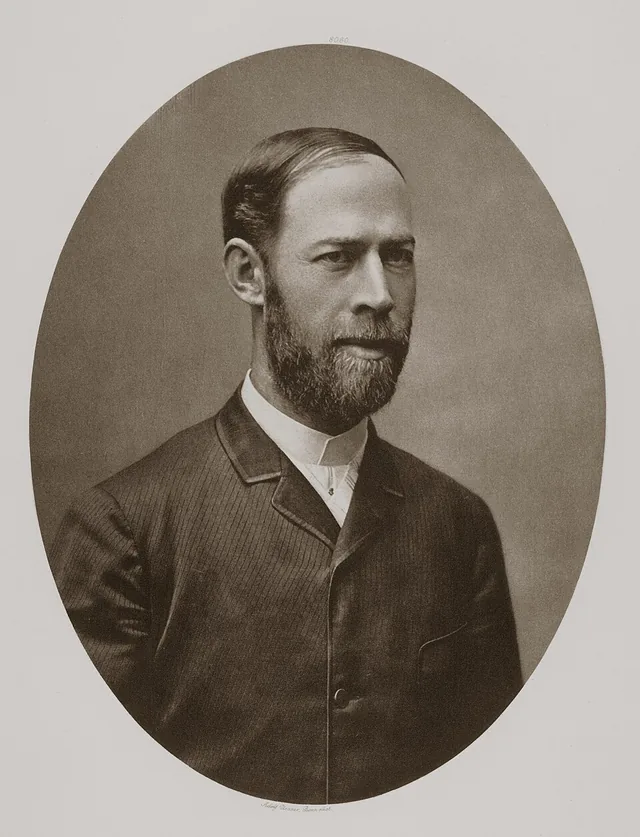
- Robert Krewaldt, Kaiserplatz 16, Bonn · public domain · Wikimedia Commons
Something wrong here?Ask us to correct or remove it.