


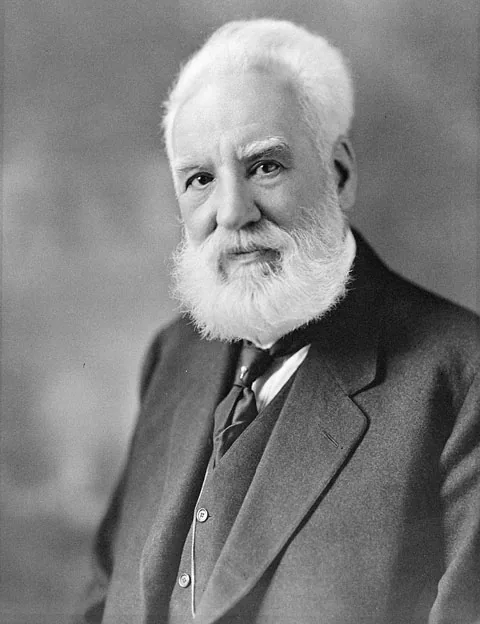


Alexander Graham Bell
Scientist and inventor · United Kingdom · 1847–1922
Birth date sourced. Birth time unknown.
Moon sign undetermined. The Moon crossed from Virgo into Libra during that civil day. Everything below uses only what the complete civil day settles.Mutable signs carry four of the nine placements whose signs are settled — the broadest certain weighting in the chart. The mutable signs sit where one season is already becoming the next — the scheme’s translators.
Positions at 12:00 civil time in Edinburgh, a reference instant, not a birth time. No houses, rising sign, angles, or sect were computed.
Where the Sun actually stood
The Sun sits at 12.3° Pisces — the second decan, 10°–20°, which the tradition sub-rules by the Moon. Degrees matter more than the sign label here: two people born a fortnight apart share Pisces and share almost nothing else about where the Sun actually stood.
The fast planets
Day to day the chart speaks through Mercury in Pisces (25.3°), Venus in Aries (0.8°), Mars in Capricorn (14.9°): a mind that absorbs before it argues, taste that runs toward the vivid and the immediate, drive that grinds rather than flares.
The angles that hold
The day's firmest angle joins Mars and Uranus — a square holding at 2.5°. Right angles are where the scheme puts its grit. A square asks two functions to work in a mode neither would have chosen. Behind it, the Sun sextile Mars at 2.5°, and Jupiter square Saturn at 3.7° — both still well inside the orbs this site uses. Each angle here was measured at every hour of the civil day and held; whatever the missing clock said, this geometry was in it.
What the angles build
The day-stable angles form no closed figure. Nothing funnels; each aspect is its own negotiation, which the tradition reads as a chart of separate treaties rather than one campaign.
The classical map
Four planets here sit in a sign the classical scheme scores. Mercury in Pisces at 25.3° is in fall — the tradition’s uphill placement, strength earned rather than given; Venus in Aries at 0.8° is in detriment — the planet opposite its home, working against the grain; Mars in Capricorn at 14.9° is in exaltation — the tradition’s honoured-guest placement, working at its best; Jupiter in Gemini at 8.2° is in detriment. Condition, not character: that is all the dignity table ever measured.
The shape of the whole
Balance, counted honestly across the 9 placements whose signs hold for the whole day: elements water 3, fire 3, air 2, earth 1; modalities mutable 4, cardinal 4, fixed 1. Nothing here ran retrograde — all ten in direct motion that day.
The Moon is genuinely open
The Moon crossed from Virgo into Libra during that day at the birthplace, travelling 11.8° between one midnight and the next. A birth time would settle it in a second; there isn’t one. So the Moon stays unnamed here — the alternative is a guess wearing the clothes of a fact.
Where this comes fromSources, revisions, and exactly what this chart assumes
- Source article
- Alexander Graham Bell · revision 1366001031
- Wikidata
- Q34286 · revision 2520280946
- Retrieved
- 2026-07-26T18:47:50.947Z
- Birth date
- 1847-03-03 · day precision · proleptic-gregorian
- Birthplace
- Edinburgh, United Kingdom · Q23436
- Coordinates
- 55.9533, -3.1892 · from Edinburgh (Q23436)
- Birth-time evidence in this profile
- none — Wikidata carries no birth-time claim for this person
- Reference instant
- 1847-03-03T12:12:45.000Z · noon civil time, not a birth time
- Omitted
- Rising sign, houses, angles, and sect. All require a birth time.
- Unknown-time range
- Moon travelled 11.82° · Moon sign undetermined. The Moon crossed from Virgo into Libra during that civil day.
- Engine
- astronomy-engine (repository dependency) · @zodiacs/engine/internal/math
- Portrait
- Moffett Studio · public domain · Wikimedia Commons
Something wrong here? Ask us to correct or remove it.