


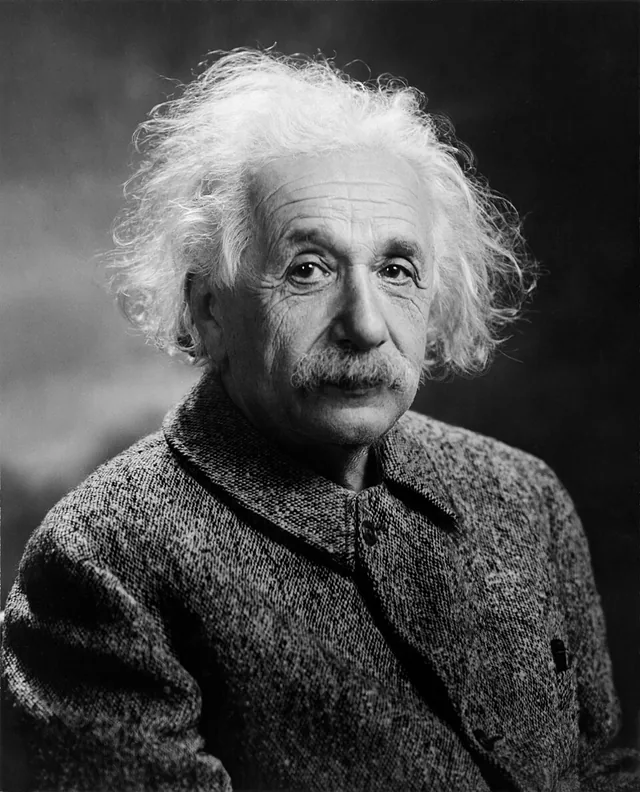


Albert Einstein
Theoretical physicist · Germany · 1879–1955
Birth date sourced. Birth time unknown.
The Moon remained in Sagittarius throughout that civil day. Everything below uses only what the complete civil day settles.Four of the ten placements whose signs are settled fall in cardinal signs, the widest weighting the unknown hour leaves certain. Cardinal weight is read as initiative: the instinct to be the reason something began.
Positions at 12:00 civil time in Ulm, a reference instant, not a birth time. No houses, rising sign, angles, or sect were computed.
Where the Sun actually stood
The Sun sits at 23.5° Pisces — the third decan, 20°–30°, which the tradition sub-rules by Mars. Degrees matter more than the sign label here: two people born a fortnight apart share Pisces and share almost nothing else about where the Sun actually stood.
The angles that hold
Mercury and Saturn hold the closest angle here — a conjunction, 1.0° wide. The tradition stops reading a conjunction as two things. It is one appetite with two names, and it moves together or not at all. Behind it, the Sun sextile Pluto at 1.2°, and Mars trine Pluto at 2.2° — both still well inside the orbs this site uses. These angles were checked through every hour of that civil day and survive throughout, which is why an unrecorded hour does not disturb them.
The classical map
The dignity table, which predates the outer planets and only ever spoke for seven, marks three placements here. Venus in Aries at 17.0° is in detriment — the planet opposite its home, working against the grain; Mars in Capricorn at 26.9° is in exaltation — the tradition’s honoured-guest placement, working at its best; Saturn in Aries at 4.2° is in fall — the tradition’s uphill placement, strength earned rather than given. Dignity is a statement about conditions, not about worth.
The shape of the whole
Counting only the 10 placements whose signs hold for the whole day, the chart runs 4 fire, 4 earth, 1 water, 1 air by element and 4 cardinal, 3 mutable, 3 fixed by modality. A fire emphasis is read as appetite for the first move, with information gathered by doing rather than before doing. Uranus was retrograde — the backward drift a body appears to make as the Earth overtakes it, read in the scheme as a function that reviews before it releases.
The Moon, and how far it can move
The Moon stayed in Sagittarius for the whole of that day at the birthplace, covering 13.9° between midnight and midnight. Fast enough that its degree is approximate, slow enough that its sign is not in doubt. At the noon reference it stands at 14.8°.
Where this comes fromSources, revisions, and exactly what this chart assumes
- Source article
- Albert Einstein · revision 1365975877
- Wikidata
- Q937 · revision 2522560668
- Retrieved
- 2026-07-25T17:05:12.504Z
- Birth date
- 1879-03-14 · day precision · proleptic-gregorian
- Birthplace
- Ulm, Germany · Q3012
- Coordinates
- 48.3986, 9.9911 · from Ulm (Q3012)
- Birth-time evidence in this profile
- none — Wikidata carries no birth-time claim for this person
- Reference instant
- 1879-03-14T11:20:02.000Z · noon civil time, not a birth time
- Omitted
- Rising sign, houses, angles, and sect. All require a birth time.
- Unknown-time range
- Moon travelled 13.91° · The Moon remained in Sagittarius throughout that civil day.
- Engine
- astronomy-engine (repository dependency) · @zodiacs/engine/internal/math
- Portrait
- Oren Jack Turner · public domain · Wikimedia Commons
Something wrong here? Ask us to correct or remove it.