


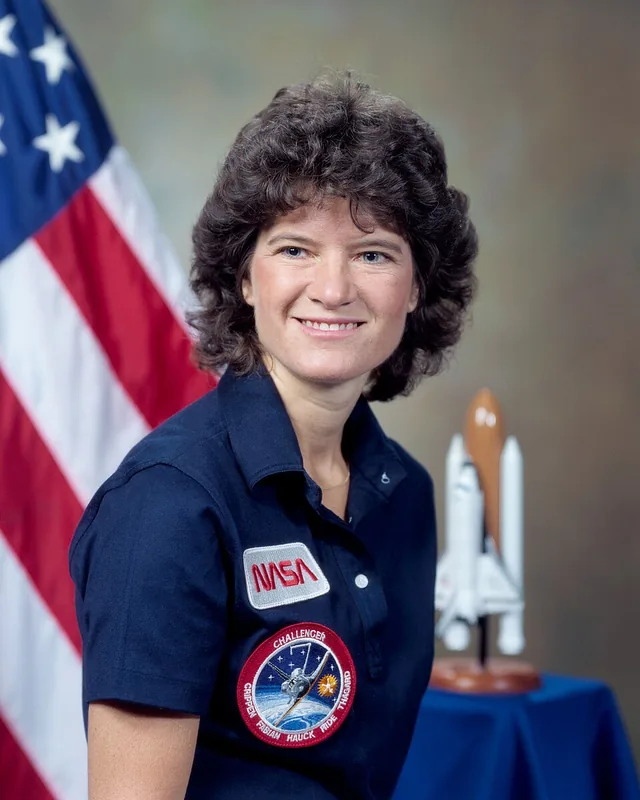


Sally Ride
Astronaut and physicist · United States · 1951–2012
Birth date sourced. Birth time unknown.
The Moon remained in Aquarius throughout that civil day. Everything below uses only what the complete civil day settles.0.6° separates Venus and Neptune from an exact square; at that range taste and imagination read as one mechanism. A square is friction that produces motion — the aspect the tradition credits with building capability precisely by refusing to be comfortable.
Positions at 12:00 civil time in Los Angeles, a reference instant, not a birth time. No houses, rising sign, angles, or sect were computed.
Where the Sun actually stood
At noon on that date the Sun stood at 4.7° Gemini, inside the first decan (0°–10°), whose traditional sub-ruler is Mercury. The decan is the older, finer division — it is what the sign looks like once you stop rounding it to thirty degrees.
Closer to the ground
Day to day the chart speaks through Mercury in Taurus (10.0°), Venus in Cancer (17.6°), Mars in Gemini (3.6°): thought with its feet on the ground, attraction that works by atmosphere, effort aimed through strategy and words.
The angles that hold
The tightest geometry in the chart puts Jupiter at right angles from Uranus, 0.4° off exact. A square is friction that produces motion — the aspect the tradition credits with building capability precisely by refusing to be comfortable. Behind it, Neptune sextile Pluto at 0.6°, and Venus square Neptune at 0.6° — both still well inside the orbs this site uses. All of it stands whatever the hour was: each angle was tested from midnight to midnight before it was written down.
What the angles build
The Moon makes no major aspect that survives the day; the old reading gives such a planet autonomy — it acts alone, sometimes loudly.
The classical map
The dignity table has nothing to say about this chart. All seven classical planets sit in signs it treats as neutral, so the reading rests entirely on placement and angle.
The shape of the whole
Balance, counted honestly across the 10 placements whose signs hold for the whole day: elements air 4, earth 2, water 2, fire 2; modalities cardinal 4, mutable 3, fixed 3. Saturn and Neptune were retrograde — apparent retreat against the stars, which the old reading takes as a function working from the inside first.
The Moon, and how far it can move
The Moon stayed in Aquarius for the whole of that day at the birthplace, covering 13.8° between midnight and midnight. That is quick enough to make the exact degree a neighbourhood rather than an address, and slow enough to leave the sign settled. At the noon reference it stands at 21.4°.
Where this comes fromSources, revisions, and exactly what this chart assumes
- Source article
- Sally Ride · revision 1365691685
- Wikidata
- Q49285 · revision 2520569097
- Retrieved
- 2026-07-26T18:47:50.947Z
- Birth date
- 1951-05-26 · day precision · proleptic-gregorian
- Birthplace
- Los Angeles, United States · Q65
- Coordinates
- 34.0522, -118.2437 · from Los Angeles (Q65)
- Birth-time evidence in this profile
- none — Wikidata carries no birth-time claim for this person
- Reference instant
- 1951-05-26T19:00:00.000Z · noon civil time, not a birth time
- Omitted
- Rising sign, houses, angles, and sect. All require a birth time.
- Unknown-time range
- Moon travelled 13.82° · The Moon remained in Aquarius throughout that civil day.
- Engine
- astronomy-engine (repository dependency) · @zodiacs/engine/internal/math
- Portrait
- NASA; retouched by Coffeeandcrumbs · public domain · Wikimedia Commons
Something wrong here? Ask us to correct or remove it.