



People · sourced chart

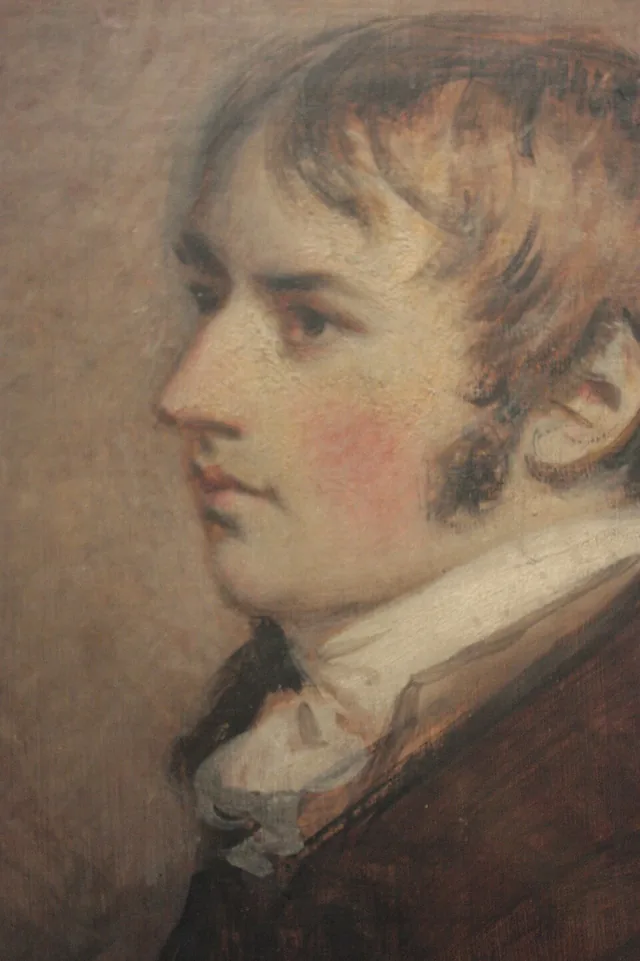
John Constable
Painter · United Kingdom · 1776–1837
Birth date sourced. Birth time unknown.The Moon remained in Aries throughout that civil day. Everything below uses only what the complete civil day settles.
The day, read honestly
Four of the ten placements whose signs are settled stand in Gemini — the Sun, Venus, Mars and Uranus. The placements whose signs could change with an unknown hour are not counted. A cluster that size becomes the section the rest of the chart plays around.
Positions at 12:00 civil time in East Bergholt—a reference instant, not a birth time. No houses, rising sign, angles, or sect were computed.
Where the Sun actually stood
Gemini, but precisely: 21.0°, third decan, 20°–30°, under Saturn in the triplicity scheme. The tradition kept these divisions because thirty degrees is a long street.
The fast planets
The personal planets sit Mercury at 15.5° Cancer, Venus at 4.5° Gemini, Mars at 5.2° Gemini. Mercury in a water sign reads as a mind that absorbs before it argues; Venus in a air sign reads as taste led by wit and proportion; Mars in a air sign reads as drive that argues its way forward.
The angles that hold
Start where the chart is tightest — Venus conjunction Mars, 0.7° of separation. Two bodies in the same degree are not read as neighbours but as a merger: whatever one wants, the other is already funding. Behind it, Mercury square Saturn at 0.9°, and the Sun square Neptune at 1.2° — both still well inside the orbs this site uses. These angles were checked through every hour of that civil day and survive throughout, which is why an unrecorded hour does not disturb them.
What the angles build
The Moon stands apart from every major angle the day held — the tradition reads an unaspected planet as a voice that speaks on its own schedule, unmodulated by the rest of the chart.
The classical map
The classical table has two entries for this chart. Jupiter in Cancer at 0.6° is in exaltation — the tradition’s honoured-guest placement, working at its best; Saturn in Libra at 14.6° is in exaltation. None of these labels is a verdict on a person; they describe how a function is situated, nothing more.
The shape of the whole
Of the 10 placements whose signs hold for the whole day: 5 in air, 2 in water, 2 in earth, 1 in fire by element, 5 mutable, 5 cardinal by modality. Air signs carry exchange in the scheme — comparison, argument, the sentence that makes the situation legible. Saturn and Pluto were retrograde — apparent backward motion from where the Earth sits, which the tradition reads as a function turned inward before it is turned out.
The Moon, and how far it can move
The Moon stayed in Aries for the whole of that day at the birthplace, covering 14.1° between midnight and midnight. That is quick enough to make the exact degree a neighbourhood rather than an address, and slow enough to leave the sign settled. At the noon reference it stands at 21.6°.
Where this comes fromSources, revisions, and exactly what this chart assumes
- Source article
- John Constable · revision 1364711696
- Wikidata
- Q159297 · revision 2522290669
- Retrieved
- 2026-07-26T18:47:50.947Z
- Birth date
- 1776-06-11 · day precision · proleptic-gregorian
- Birthplace
- East Bergholt, United Kingdom · Q2185491
- Coordinates
- 51.9759, 1.0168 · from East Bergholt
- Reference instant
- 1776-06-11T12:01:15.000Z · noon civil time, not a birth time
- Omitted
- Rising sign, houses, angles, and sect—all require a birth time.
- Unknown-time range
- Moon travelled 14.11° · The Moon remained in Aries throughout that civil day.
- Engine
- astronomy-engine (repository dependency) · @zodiacs/engine/internal/math
- Portrait
- Stephencdickson · CC BY-SA 4.0 · Wikimedia Commons
Something wrong here?Ask us to correct or remove it.