



People · sourced chart

Willie Mays
Baseball player · United States · 1931–2024
Birth date sourced. Birth time unknown.The Moon remained in Capricorn throughout that civil day. Everything below uses only what the complete civil day settles.
The day, read honestly
The chart's headline is a trine: Venus and Mars within 0.2°, taste wired to drive. A trine runs downhill — the talent that never announces itself because it never had to.
Positions at 12:00 civil time in Westfield—a reference instant, not a birth time. No houses, rising sign, angles, or sect were computed.
Where the Sun actually stood
Measured rather than labelled, the Sun holds 15.2° Taurus: the second decan, whose classical sub-ruler is Mercury. A earth sign, read here in its second face.
Closer to the ground
For the fast movers, Mercury was at 5.3° Taurus, Venus was at 12.7° Aries, Mars was at 12.9° Leo. Read together: a mind that trusts the measured and the checked; taste that runs toward the vivid and the immediate; drive that ignites on contact.
The angles that hold
Start where the chart is tightest — Venus trine Mars, 0.2° of separation. The scheme reads trines as water finding its level: effortless, and invisible to the person living it. Behind it, the Sun sextile Jupiter at 0.5°, and Jupiter square Uranus at 1.3° — both still well inside the orbs this site uses. Each angle here was measured at every hour of the civil day and held; whatever the missing clock said, this geometry was in it.
Figures in the geometry
The Moon opposes Jupiter while both square Venus. The t-square is the figure the old texts trusted for output: friction with a fixed address.
The classical map
The classical table has four entries for this chart. The Moon in Capricorn at 12.8° is in detriment — the planet opposite its home, working against the grain; Venus in Aries at 12.7° is in detriment; Jupiter in Cancer at 15.7° is in exaltation — the tradition’s honoured-guest placement, working at its best; Saturn in Capricorn at 23.3° is in domicile — the planet in its own sign, running on home rules. The old table grades terrain, not talent — a placement in fall works uphill, nothing more.
The shape of the whole
Tallied where the signs are certain — 10 placements whose signs hold for the whole day — the chart gives earth 5, fire 3, water 2, and cardinal 6, fixed 3, mutable 1 across the modes. Earth signs hold the scheme’s slow end, where results are measured in what survives rather than what starts. No settled placement falls in air — an absence the tradition treats as information, not as a defect. Mercury, Saturn and Neptune were retrograde — apparent backward motion from where the Earth sits, which the tradition reads as a function turned inward before it is turned out.
The Moon, and how far it can move
The Moon stayed in Capricorn for the whole of that day at the birthplace, covering 12.9° between midnight and midnight. Fast enough that its degree is approximate, slow enough that its sign is not in doubt. At the noon reference it stands at 12.8°.
Where this comes fromSources, revisions, and exactly what this chart assumes
- Source article
- Willie Mays · revision 1364594467
- Wikidata
- Q561852 · revision 2519303899
- Retrieved
- 2026-07-26T18:47:50.947Z
- Birth date
- 1931-05-06 · day precision · proleptic-gregorian
- Birthplace
- Westfield, United States · Q107535361
- Coordinates
- 33.4846, -86.9405 · from Westfield
- Reference instant
- 1931-05-06T17:00:00.000Z · noon civil time, not a birth time
- Omitted
- Rising sign, houses, angles, and sect—all require a birth time.
- Unknown-time range
- Moon travelled 12.92° · The Moon remained in Capricorn throughout that civil day.
- Engine
- astronomy-engine (repository dependency) · @zodiacs/engine/internal/math
- Portrait
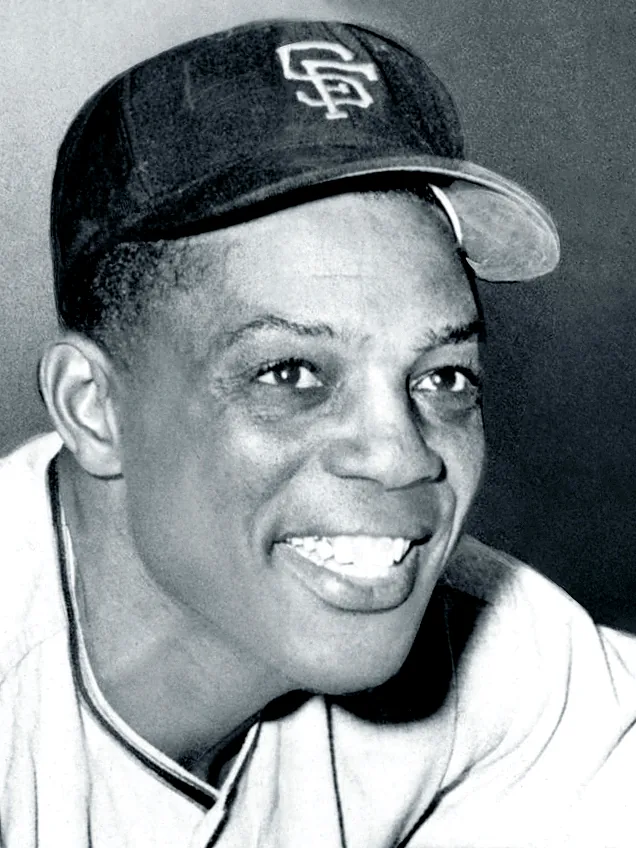
- New York World-Telegram and the Sun staff photographer, William C. Greene · public domain · Wikimedia Commons
Something wrong here?Ask us to correct or remove it.