



People · sourced chart

W. G. Grace
Cricketer and physician · United Kingdom · 1848–1915
Birth date sourced. Birth time unknown.The Moon remained in Aquarius throughout that civil day. Everything below uses only what the complete civil day settles.
The day, read honestly
Tightest of all, Mercury holds a square to Pluto at 0.1° — close enough to weld thinking to depth. Nothing in a square flows; everything in it works. The old texts kept squares for the charts they respected.
Positions at 12:00 civil time in Downend—a reference instant, not a birth time. No houses, rising sign, angles, or sect were computed.
Where the Sun actually stood
25.9° of Cancer is the Sun's exact seat — third decan, 20°–30°, sub-ruled by Jupiter in the old triplicity scheme. The degree is the address; the sign is only the street.
Closer to the ground
For the fast movers, Mercury was at 27.8° Cancer, Venus was at 24.7° Cancer, Mars was at 25.4° Leo. Read together: thought steeped in tone and memory; attraction that works by atmosphere; effort spent in bursts and openings.
The angles that hold
Mercury to Pluto is the closest call of the day, a square within 0.1°. Right angles are where the scheme puts its grit. A square asks two functions to work in a mode neither would have chosen. Behind it, Venus trine Saturn at 0.5°, and the Sun trine Saturn at 0.7° — both still well inside the orbs this site uses. The unknown hour cannot unmake any of this: every aspect named survived all twenty-five samples of the day.
The standing structure
No closed figure — no grand trine, t-square, or grand cross — holds among the day-stable angles. The chart distributes its tension pair by pair rather than through one standing structure.
The classical map
The dignity table has nothing to say about this chart. All seven classical planets sit in signs it treats as neutral, so the reading rests entirely on placement and angle.
The shape of the whole
Balance, counted honestly across the 10 placements whose signs hold for the whole day: elements water 5, fire 4, air 1; modalities cardinal 5, fixed 3, mutable 2. A water emphasis keeps long books: little is forgotten, and nothing is felt only once. No settled placement falls in earth — an absence the tradition treats as information, not as a defect. Mercury, Saturn and Neptune were retrograde — motion that reverses only from this vantage point, and which the old reading treats as delay used for revision.
The Moon, and how far it can move
The Moon stayed in Aquarius for the whole of that day at the birthplace, covering 13.4° between midnight and midnight. The missing clock moves the Moon by half a sign at most here, and the boundary was never close. At the noon reference it stands at 21.8°.
Where this comes fromSources, revisions, and exactly what this chart assumes
- Source article
- W. G. Grace · revision 1365018357
- Wikidata
- Q616068 · revision 2517662684
- Retrieved
- 2026-07-26T18:47:50.947Z
- Birth date
- 1848-07-18 · day precision · proleptic-gregorian
- Birthplace
- Downend, United Kingdom · Q5303097
- Coordinates
- 51.4947, -2.5049 · from Downend
- Reference instant
- 1848-07-18T12:00:00.000Z · noon civil time, not a birth time
- Omitted
- Rising sign, houses, angles, and sect—all require a birth time.
- Unknown-time range
- Moon travelled 13.45° · The Moon remained in Aquarius throughout that civil day.
- Engine
- astronomy-engine (repository dependency) · @zodiacs/engine/internal/math
- Portrait
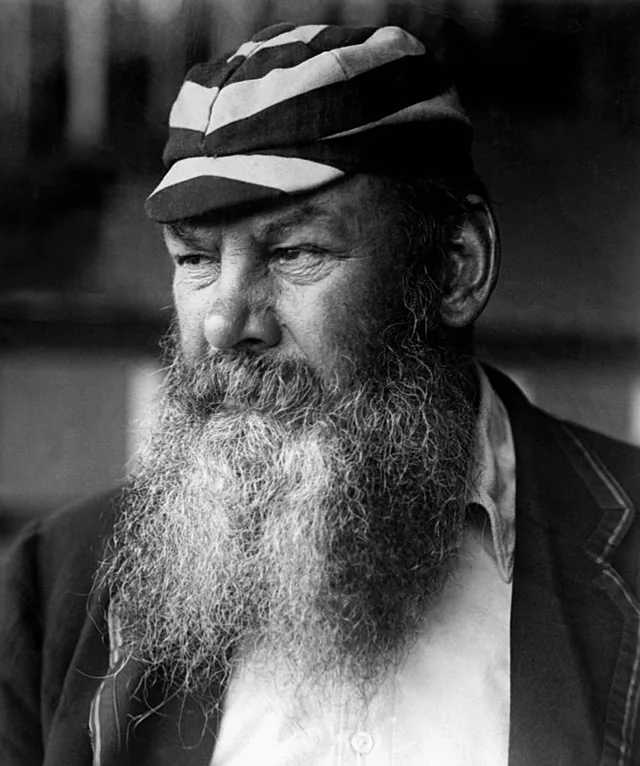
- George Beldam · public domain · Wikimedia Commons
Something wrong here?Ask us to correct or remove it.