


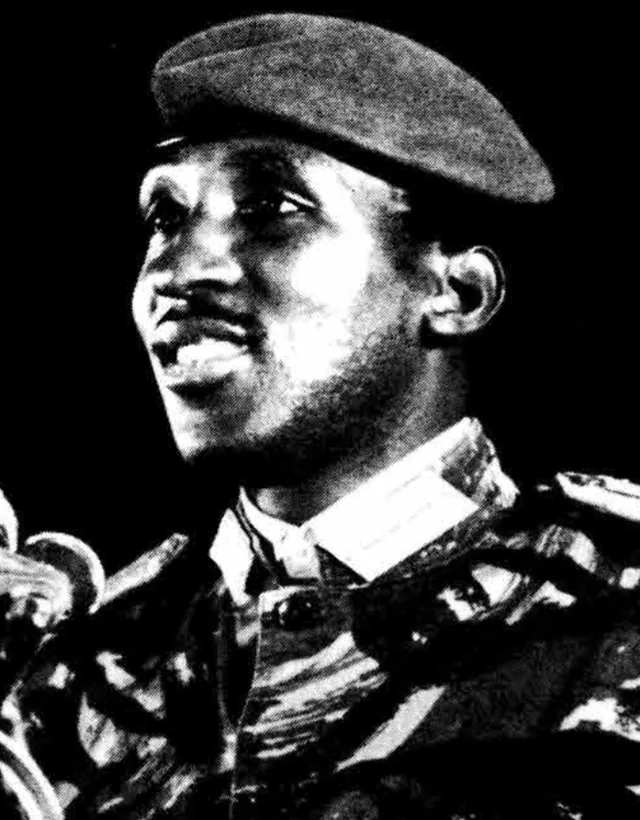


Thomas Sankara
Politician · Burkina Faso · 1949–1987
Birth date sourced. Birth time unknown.
The Moon remained in Capricorn throughout that civil day. Everything below uses only what the complete civil day settles.Four of the ten placements whose signs are settled fall in cardinal signs, the widest weighting the unknown hour leaves certain. The cardinal signs begin things; a chart weighted there treats every stall as a starting gun.
Positions at 12:00 civil time in Yako, a reference instant, not a birth time. No houses, rising sign, angles, or sect were computed.
Where the Sun actually stood
At the noon reference the Sun sits 29.3° into Sagittarius — the third decan, which the old scheme hands to the Sun. Same sign, different decan, different chart.
The personal registers
Mercury holds 15.3° Capricorn, Venus holds 11.7° Aquarius, Mars holds 28.1° Virgo — in the old shorthand, thought with its feet on the ground; attraction that begins as conversation; effort banked steadily until it tells.
The angles that hold
The day's firmest angle joins Neptune and Pluto — a sextile holding at 0.8°. Sextiles are read as standing invitations — productive exactly as often as they are accepted. Behind it, the Sun square Mars at 1.2°, and Mercury square Neptune at 1.8° — both still well inside the orbs this site uses. All of it stands whatever the hour was: each angle was tested from midnight to midnight before it was written down.
Figures in the geometry
The Sun opposes Uranus while both square Mars. The t-square is the figure the old texts trusted for output: friction with a fixed address. The Moon makes no major aspect that survives the day; the old reading gives such a planet autonomy — it acts alone, sometimes loudly.
The classical map
The oldest layer of the scheme — seven planets, four conditions — flags a single placement in this chart. The Moon in Capricorn at 21.8° is in detriment — the planet opposite its home, working against the grain. None of this ranks anyone; dignity describes footing, and footing can be worked with.
The shape of the whole
The honest balance sheet uses the 10 placements whose signs hold for the whole day: earth 4, air 3, fire 2, water 1 across the elements, and cardinal 4, mutable 3, fixed 3 across the modalities. Uranus and Pluto were retrograde — the optical reversal the tradition reads as review — energy turned over before it is turned out.
The Moon, and how far it can move
The Moon stayed in Capricorn for the whole of that day at the birthplace, covering 13.8° between midnight and midnight. The missing clock moves the Moon by half a sign at most here, and the boundary was never close. At the noon reference it stands at 21.8°.
Where this comes fromSources, revisions, and exactly what this chart assumes
- Source article
- Thomas Sankara · revision 1365214443
- Wikidata
- Q202155 · revision 2519461263
- Retrieved
- 2026-07-26T18:47:50.947Z
- Birth date
- 1949-12-21 · day precision · proleptic-gregorian
- Birthplace
- Yako, Burkina Faso · Q940973
- Coordinates
- 12.9667, -2.2667 · from Yako (Q940973)
- Birth-time evidence in this profile
- none — Wikidata carries no birth-time claim for this person
- Reference instant
- 1949-12-21T12:00:00.000Z · noon civil time, not a birth time
- Omitted
- Rising sign, houses, angles, and sect. All require a birth time.
- Unknown-time range
- Moon travelled 13.84° · The Moon remained in Capricorn throughout that civil day.
- Engine
- astronomy-engine (repository dependency) · @zodiacs/engine/internal/math
- Portrait
- The Militant/ Ernest Harsch · public domain · Wikimedia Commons
Something wrong here? Ask us to correct or remove it.