


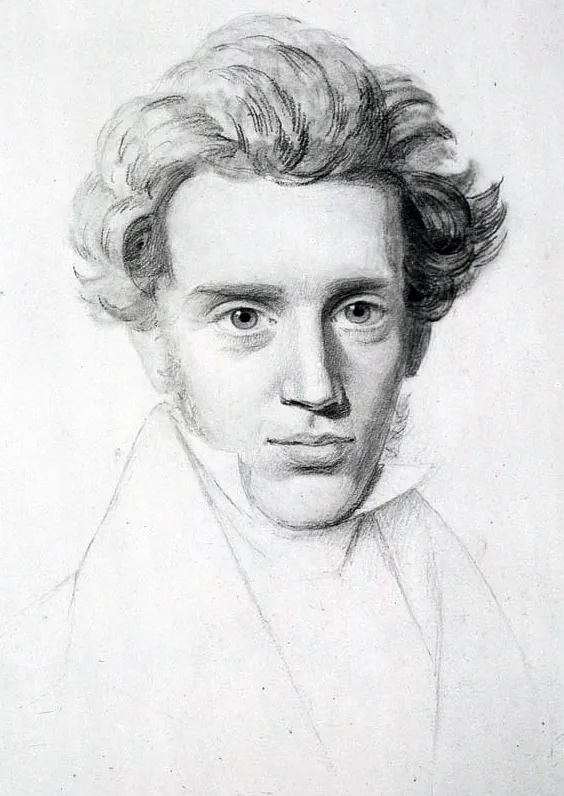

People · sourced chart

Søren Kierkegaard
Philosopher · Denmark · 1813–1855
Birth date sourced. Birth time unknown.The Moon remained in Cancer throughout that civil day. Everything below uses only what the complete civil day settles.
The day, read honestly
The Moon stands at 20.8° Cancer, in domicile — the planet in its own sign, running on home rules. Of everything the chart can be read for without a birth time, that is the loudest single fact in it.
Positions at 12:00 civil time in Copenhagen—a reference instant, not a birth time. No houses, rising sign, angles, or sect were computed.
Where the Sun actually stood
At the noon reference the Sun sits 14.5° into Taurus — the second decan, which the old scheme hands to Mercury. Same sign, different decan, different chart.
The personal registers
For the fast movers, Mercury was at 25.0° Aries, Venus was at 9.2° Taurus, Mars was at 26.7° Capricorn. Read together: thought that arrives already in motion; attraction that grows by reliability; effort banked steadily until it tells.
The angles that hold
Start where the chart is tightest — Mars sextile Uranus, 0.2° of separation. A sextile pays out only on effort; the scheme calls it opportunity rather than gift. Behind it, Saturn sextile Pluto at 1.0°, and Mercury square Mars at 1.7° — both still well inside the orbs this site uses. All of it stands whatever the hour was: each angle was tested from midnight to midnight before it was written down.
What the angles build
Mars opposes Jupiter while both square Mercury. A t-square aims the whole axis at its apex planet; the tradition reads it as the chart’s standing assignment.
The classical map
Read against the old dignities, four placements stand out. The Moon in Cancer at 20.8° is in domicile — the planet in its own sign, running on home rules; Venus in Taurus at 9.2° is in domicile; Mars in Capricorn at 26.7° is in exaltation — the tradition’s honoured-guest placement, working at its best; Saturn in Capricorn at 19.3° is in domicile. None of this ranks anyone; dignity describes footing, and footing can be worked with.
The shape of the whole
Counting only the 10 placements whose signs hold for the whole day, the chart runs 4 earth, 3 water, 3 fire by element and 4 fixed, 4 cardinal, 2 mutable by modality. Earth signs hold the scheme’s slow end, where results are measured in what survives rather than what starts. No settled placement falls in air — an absence the tradition treats as information, not as a defect. Saturn, Uranus and Neptune were retrograde — apparent backward motion from where the Earth sits, which the tradition reads as a function turned inward before it is turned out.
The Moon, and how far it can move
The Moon stayed in Cancer for the whole of that day at the birthplace, covering 13.9° between midnight and midnight. That is quick enough to make the exact degree a neighbourhood rather than an address, and slow enough to leave the sign settled. At the noon reference it stands at 20.8°.
Where this comes fromSources, revisions, and exactly what this chart assumes
- Source article
- Søren Kierkegaard · revision 1365518285
- Wikidata
- Q6512 · revision 2523025174
- Retrieved
- 2026-07-26T18:47:50.947Z
- Birth date
- 1813-05-05 · day precision · proleptic-gregorian
- Birthplace
- Copenhagen, Denmark · Q1748
- Coordinates
- 55.6761, 12.5689 · from Copenhagen
- Reference instant
- 1813-05-05T11:06:32.000Z · noon civil time, not a birth time
- Omitted
- Rising sign, houses, angles, and sect—all require a birth time.
- Unknown-time range
- Moon travelled 13.86° · The Moon remained in Cancer throughout that civil day.
- Engine
- astronomy-engine (repository dependency) · @zodiacs/engine/internal/math
- Portrait
- La Biblioteca Real de Dinamarca · public domain · Wikimedia Commons
Something wrong here?Ask us to correct or remove it.