



People · sourced chart

Octavia Hill
Social reformer and writer · United Kingdom · 1838–1912
Birth date sourced. Birth time unknown.The Moon remained in Cancer throughout that civil day. Everything below uses only what the complete civil day settles.
The day, read honestly
Four of the ten placements whose signs are settled stand in Sagittarius — the Sun, Mercury, Venus and Saturn. The placements whose signs could change with an unknown hour are not counted. A cluster that size becomes the section the rest of the chart plays around.
Positions at 12:00 civil time in Wisbech—a reference instant, not a birth time. No houses, rising sign, angles, or sect were computed.
Where the Sun actually stood
Measured rather than labelled, the Sun holds 10.9° Sagittarius: the second decan, whose classical sub-ruler is Mars. A fire sign, read here in its second face.
The fast planets
Mercury holds 26.6° Sagittarius, Venus holds 7.3° Sagittarius, Mars holds 14.3° Virgo — in the old shorthand, a mind that decides at speaking speed; taste that runs toward the vivid and the immediate; drive that grinds rather than flares.
The angles that hold
Venus to Neptune is the closest call of the day, a sextile within 0.9°. A sextile is an offer rather than a given: available when it is reached for, quiet when it is not. Behind it, Venus square Uranus at 1.4°, and the Sun square Uranus at 2.3° — both still well inside the orbs this site uses. Each angle here was measured at every hour of the civil day and held; whatever the missing clock said, this geometry was in it.
What the angles build
Mars opposes Uranus while both square the Sun. The t-square is the figure the old texts trusted for output: friction with a fixed address. The Moon stands apart from every major angle the day held — the tradition reads an unaspected planet as a voice that speaks on its own schedule, unmodulated by the rest of the chart.
The classical map
Of the seven planets the classical scheme judges, two sit in a sign it has an opinion about. The Moon in Cancer at 7.3° is in domicile — the planet in its own sign, running on home rules; Mercury in Sagittarius at 26.6° is in detriment — the planet opposite its home, working against the grain. Condition, not character: that is all the dignity table ever measured.
The shape of the whole
Counting only the 10 placements whose signs hold for the whole day, the chart runs 5 fire, 2 water, 2 air, 1 earth by element and 6 mutable, 3 cardinal, 1 fixed by modality. Pluto was retrograde — apparent retreat against the stars, which the old reading takes as a function working from the inside first.
The Moon, and how far it can move
The Moon stayed in Cancer for the whole of that day at the birthplace, covering 13.7° between midnight and midnight. Fast enough that its degree is approximate, slow enough that its sign is not in doubt. At the noon reference it stands at 7.3°.
Where this comes fromSources, revisions, and exactly what this chart assumes
- Source article
- Octavia Hill · revision 1363651444
- Wikidata
- Q437462 · revision 2510679258
- Retrieved
- 2026-07-26T18:47:50.947Z
- Birth date
- 1838-12-03 · day precision · proleptic-gregorian
- Birthplace
- Wisbech, United Kingdom · Q1012031
- Coordinates
- 52.6642, 0.1603 · from Wisbech
- Reference instant
- 1838-12-03T12:01:15.000Z · noon civil time, not a birth time
- Omitted
- Rising sign, houses, angles, and sect—all require a birth time.
- Unknown-time range
- Moon travelled 13.72° · The Moon remained in Cancer throughout that civil day.
- Engine
- astronomy-engine (repository dependency) · @zodiacs/engine/internal/math
- Portrait
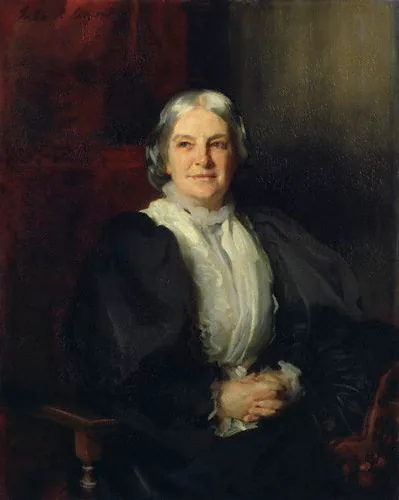
- John Singer Sargent · public domain · Wikimedia Commons
Something wrong here?Ask us to correct or remove it.