



People · sourced chart

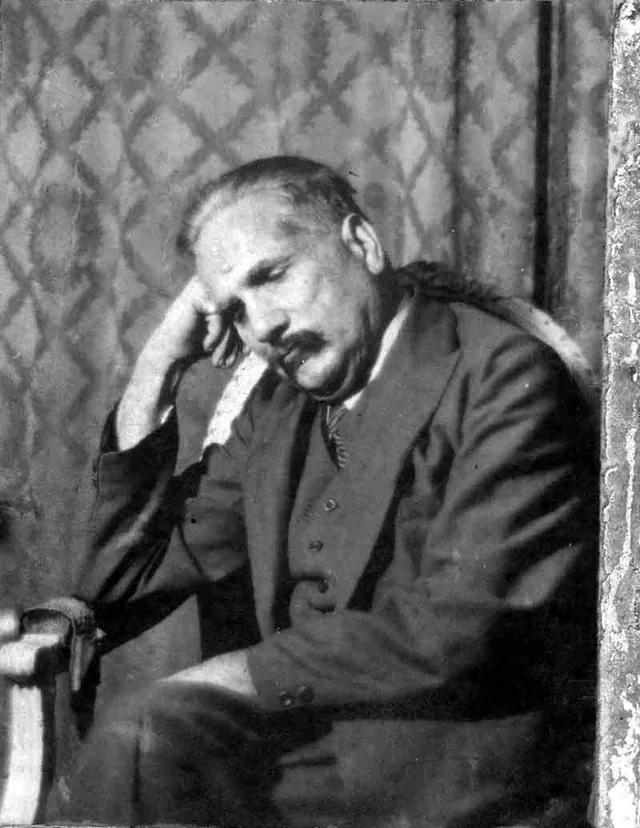
Muhammad Iqbal
Philosopher and politician · Pakistan · 1877–1938
Birth date sourced. Birth time unknown.Moon sign undetermined. The Moon crossed from Sagittarius into Capricorn during that day. Everything below uses only what the complete civil day settles.
The day, read honestly
Tightest of all, Mercury holds a trine to Saturn at 0.8° — close enough to weld thinking to structure. A trine runs downhill — the talent that never announces itself because it never had to.
Positions at 12:00 civil time in Sialkot—a reference instant, not a birth time. No houses, rising sign, angles, or sect were computed.
Where the Sun actually stood
At the noon reference the Sun sits 17.0° into Scorpio — the second decan, which the old scheme hands to Jupiter. Same sign, different decan, different chart.
The fast planets
The personal planets sit Mercury at 14.4° Scorpio, Venus at 1.7° Capricorn, Mars at 15.6° Pisces. Mercury in a water sign reads as thought steeped in tone and memory; Venus in a earth sign reads as attraction that grows by reliability; Mars in a water sign reads as effort that surges when it matters.
The angles that hold
The day's firmest angle joins Mercury and Saturn — a trine holding at 0.8°. A third of the circle is the tradition’s friendliest distance — same element, shared assumptions, no translation required. Behind it, Venus conjunction Jupiter at 0.9°, and Mercury trine Mars at 1.2° — both still well inside the orbs this site uses. All of it stands whatever the hour was: each angle was tested from midnight to midnight before it was written down.
The standing structure
Venus, Uranus, Neptune close a triangle of trines. A grand trine is read as self-sufficiency in one element: the current circulates whether or not anything is asked of it.
The classical map
The dignity table, which predates the outer planets and only ever spoke for seven, marks one placement here. Jupiter in Capricorn at 2.6° is in fall — the tradition’s uphill placement, strength earned rather than given. The table describes circumstance rather than quality — a planet in detriment is inconvenienced, not diminished.
The shape of the whole
Of the 9 placements whose signs hold for the whole day: 4 in water, 4 in earth, 1 in fire by element, 5 fixed, 2 cardinal, 2 mutable by modality. A water emphasis reads as porousness: the room is registered whole, long before it is analysed in parts. No settled placement falls in air — an absence the tradition treats as information, not as a defect. Saturn, Neptune and Pluto were retrograde — the optical reversal the tradition reads as review — energy turned over before it is turned out.
The Moon is genuinely open
The Moon crossed from Sagittarius into Capricorn during that day at the birthplace, travelling 12.7° between one midnight and the next. The hour would decide it; no hour was recorded. The reading keeps the question open rather than flipping a coin dressed as astrology.
Where this comes fromSources, revisions, and exactly what this chart assumes
- Source article
- Muhammad Iqbal · revision 1366126308
- Wikidata
- Q484141 · revision 2518708656
- Retrieved
- 2026-07-26T18:47:50.947Z
- Birth date
- 1877-11-09 · day precision · proleptic-gregorian
- Birthplace
- Sialkot, Pakistan · Q643883
- Coordinates
- 32.5000, 74.5333 · from Sialkot
- Reference instant
- 1877-11-09T07:31:48.000Z · noon civil time, not a birth time
- Omitted
- Rising sign, houses, angles, and sect—all require a birth time.
- Unknown-time range
- Moon travelled 12.68° · Moon sign undetermined. The Moon crossed from Sagittarius into Capricorn during that day.
- Engine
- astronomy-engine (repository dependency) · @zodiacs/engine/internal/math
- Portrait
- Amrita Sher-Gil · public domain · Wikimedia Commons
Something wrong here?Ask us to correct or remove it.