



People · sourced chart

Muhammad Abduh
Judge and writer · Egypt · 1849–1905
Birth date sourced. Birth time unknown.Moon sign undetermined. The Moon crossed from Pisces into Aries during that day. Everything below uses only what the complete civil day settles.
The day, read honestly
Four of the nine placements whose signs are settled fall in cardinal signs, the widest weighting the unknown hour leaves certain. The cardinal signs begin things; a chart weighted there treats every stall as a starting gun.
Positions at 12:00 civil time in Shubra Khit—a reference instant, not a birth time. No houses, rising sign, angles, or sect were computed.
Where the Sun actually stood
The Sun's exact place is 11.0° Capricorn. That falls in the second decan, 10°–20°, sub-ruled by Venus in the classical scheme — a earth sign read through a cardinal season.
The personal registers
Closer in, Mercury stands at 6.5° Capricorn; Venus stands at 20.4° Aquarius; Mars stands at 16.9° Sagittarius. The tradition reads a mind that trusts the measured and the checked from Mercury, taste led by wit and proportion from Venus, drive that ignites on contact from Mars.
The angles that hold
Nothing in the geometry sits closer than Venus and Jupiter: 1.2° from an exact opposition. An opposition is the tradition’s tug of war. Both ends are real, and the work is holding them at once rather than picking a winner. Behind it, Mars trine Uranus at 1.4°, and Venus sextile Uranus at 2.0° — both still well inside the orbs this site uses. These angles were checked through every hour of that civil day and survive throughout, which is why an unrecorded hour does not disturb them.
Figures in the geometry
Mars, Jupiter, Uranus close a triangle of trines. Three trines close into a circuit the tradition calls a grand trine — ease so complete it can idle unnoticed for years. The Moon stands apart from every major angle the day held — the tradition reads an unaspected planet as a voice that speaks on its own schedule, unmodulated by the rest of the chart.
The classical map
No planet here is at home, exalted, in detriment, or in fall. That silence from the oldest layer of the scheme is itself a result, and it moves the weight of the reading onto the geometry.
The shape of the whole
Counting only the 9 placements whose signs hold for the whole day, the chart runs 4 fire, 2 earth, 2 water, 1 air by element and 4 cardinal, 3 mutable, 2 fixed by modality. Jupiter and Pluto were retrograde — apparent backward motion from where the Earth sits, which the tradition reads as a function turned inward before it is turned out.
The Moon is genuinely open
The Moon crossed from Pisces into Aries during that day at the birthplace, travelling 13.5° between one midnight and the next. Without a recorded hour there is no honest way to say which side it was on, so this reading does not say. The Moon sign is a real question here, not a rounding error, and it needs a birth time nobody has published.
Where this comes fromSources, revisions, and exactly what this chart assumes
- Source article
- Muhammad Abduh · revision 1359331840
- Wikidata
- Q311826 · revision 2518987122
- Retrieved
- 2026-07-26T18:47:50.947Z
- Birth date
- 1849-01-01 · day precision · proleptic-gregorian
- Birthplace
- Shubra Khit, Egypt · Q5600888
- Coordinates
- 31.0275, 30.7128 · from Shubra Khit
- Reference instant
- 1849-01-01T09:54:51.000Z · noon civil time, not a birth time
- Omitted
- Rising sign, houses, angles, and sect—all require a birth time.
- Unknown-time range
- Moon travelled 13.46° · Moon sign undetermined. The Moon crossed from Pisces into Aries during that day.
- Engine
- astronomy-engine (repository dependency) · @zodiacs/engine/internal/math
- Portrait
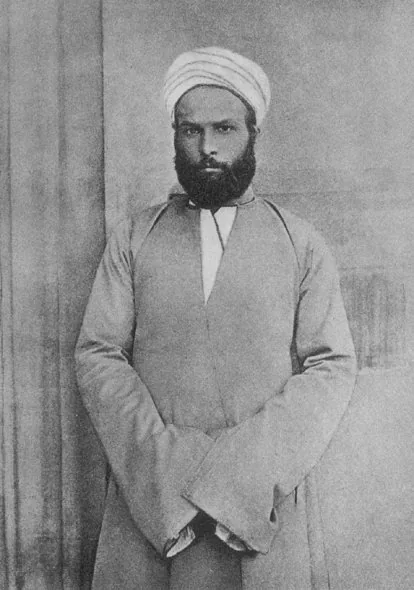
- The original uploader was Zerida at English Wikipedia. · public domain · Wikimedia Commons
Something wrong here?Ask us to correct or remove it.