



People · sourced chart

Montesquieu
Philosopher and sociologist · France · 1689–1755
Birth date sourced. Birth time unknown.Moon sign undetermined. The Moon crossed from Sagittarius into Capricorn during that day. Everything below uses only what the complete civil day settles.
The day, read honestly
Three of the nine placements whose signs are settled fall in cardinal signs, the widest weighting the unknown hour leaves certain. The four cardinal signs sit at the solstices and equinoxes — the scheme’s ignition points, and this chart is weighted to them.
Positions at 12:00 civil time in Château de la Brède—a reference instant, not a birth time. No houses, rising sign, angles, or sect were computed.
Where the Sun actually stood
Capricorn, but precisely: 29.2°, third decan, 20°–30°, under Mercury in the triplicity scheme. The tradition kept these divisions because thirty degrees is a long street.
Closer to the ground
Closer in, Mercury stands at 10.9° Capricorn; Venus stands at 2.1° Pisces; Mars stands at 12.6° Sagittarius. The tradition reads a mind that trusts the measured and the checked from Mercury, taste tuned to mood and undertow from Venus, drive that ignites on contact from Mars.
The angles that hold
Jupiter and Saturn hold the closest angle here — a square, 0.6° wide. A square is friction that produces motion — the aspect the tradition credits with building capability precisely by refusing to be comfortable. Behind it, Mercury sextile Neptune at 1.8°, and Saturn trine Neptune at 2.7° — both still well inside the orbs this site uses. Each angle here was measured at every hour of the civil day and held; whatever the missing clock said, this geometry was in it.
The standing structure
The Moon stands apart from every major angle the day held — the tradition reads an unaspected planet as a voice that speaks on its own schedule, unmodulated by the rest of the chart.
The classical map
The classical table has one entry for this chart. Venus in Pisces at 2.1° is in exaltation — the tradition’s honoured-guest placement, working at its best. None of these labels is a verdict on a person; they describe how a function is situated, nothing more.
The shape of the whole
Among the 9 placements whose signs hold for the whole day, the elements divide 4 water, 3 earth, 1 fire, 1 air; by modality, 3 cardinal, 3 mutable, 3 fixed. Water signs hold memory in the scheme, where nothing is quite finished and little is genuinely forgotten. Uranus and Pluto were retrograde — apparent backward motion from where the Earth sits, which the tradition reads as a function turned inward before it is turned out.
The Moon is genuinely open
The Moon crossed from Sagittarius into Capricorn during that day at the birthplace, travelling 12.6° between one midnight and the next. The hour would decide it; no hour was recorded. The reading keeps the question open rather than flipping a coin dressed as astrology.
Where this comes fromSources, revisions, and exactly what this chart assumes
- Source article
- Montesquieu · revision 1365313591
- Wikidata
- Q15975 · revision 2522221601
- Retrieved
- 2026-07-26T18:47:50.947Z
- Birth date
- 1689-01-18 · day precision · proleptic-gregorian
- Birthplace
- Château de la Brède, France · Q1859459
- Coordinates
- 44.6792, -0.5442 · from Château de la Brède
- Reference instant
- 1689-01-18T11:50:39.000Z · noon civil time, not a birth time
- Omitted
- Rising sign, houses, angles, and sect—all require a birth time.
- Unknown-time range
- Moon travelled 12.63° · Moon sign undetermined. The Moon crossed from Sagittarius into Capricorn during that day.
- Engine
- astronomy-engine (repository dependency) · @zodiacs/engine/internal/math
- Portrait
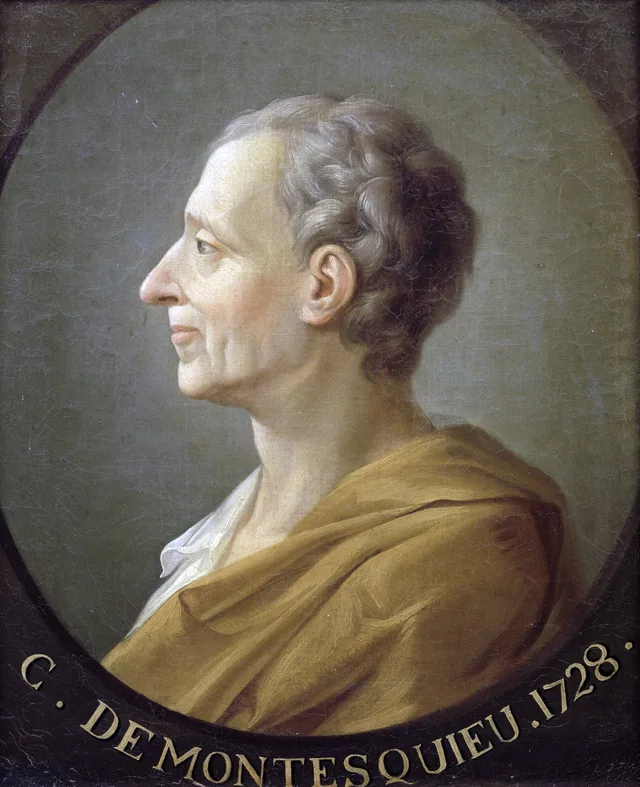
- After Jacques-Antoine Dassier · public domain · Wikimedia Commons
Something wrong here?Ask us to correct or remove it.