


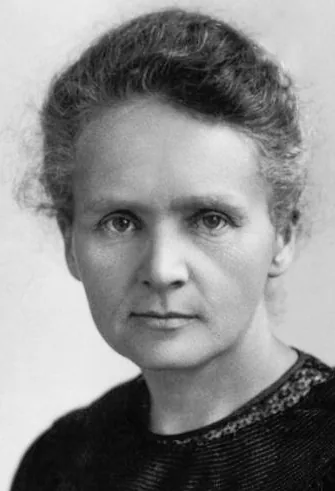


Marie Curie
Physicist and chemist · Poland · 1867–1934
Birth date sourced. Birth time unknown.
The Moon remained in Pisces throughout that civil day. Everything below uses only what the complete civil day settles.Four of the ten placements whose signs are settled stand in Scorpio — the Sun, Venus, Mars and Saturn. The placements whose signs could change with an unknown hour are not counted. A cluster that size becomes the section the rest of the chart plays around.
Positions at 12:00 civil time in Warsaw, a reference instant, not a birth time. No houses, rising sign, angles, or sect were computed.
Where the Sun actually stood
The Sun sits at 14.6° Scorpio — the second decan, 10°–20°, which the tradition sub-rules by Jupiter. Degrees matter more than the sign label here: two people born a fortnight apart share Scorpio and share almost nothing else about where the Sun actually stood.
Closer to the ground
The personal planets sit Mercury at 6.6° Sagittarius, Venus at 25.6° Scorpio, Mars at 29.6° Scorpio. Mercury in a fire sign reads as a mind that decides at speaking speed; Venus in a water sign reads as taste tuned to mood and undertow; Mars in a water sign reads as drive that moves on certainty and current.
The angles that hold
Uranus and Neptune hold the closest angle here — a square, 0.1° wide. The old texts treat a square as the aspect you feel earliest and thank latest: obstruction first, competence afterwards. Behind it, Venus conjunction Saturn at 0.3°, and the Sun opposition Pluto at 0.6° — both still well inside the orbs this site uses. Each angle here was measured at every hour of the civil day and held; whatever the missing clock said, this geometry was in it.
Figures in the geometry
The day-stable angles form no closed figure. Nothing funnels; each aspect is its own negotiation, which the tradition reads as a chart of separate treaties rather than one campaign.
The classical map
Of the seven planets the classical scheme judges, three sit in a sign it has an opinion about. Mercury in Sagittarius at 6.6° is in detriment — the planet opposite its home, working against the grain; Venus in Scorpio at 25.6° is in detriment; Mars in Scorpio at 29.6° is in domicile — the planet in its own sign, running on home rules. The old table grades terrain, not talent — a placement in fall works uphill, nothing more.
The shape of the whole
Tallied where the signs are certain — 10 placements whose signs hold for the whole day — the chart gives water 6, fire 2, air 1, earth 1, and fixed 6, mutable 2, cardinal 2 across the modes. Uranus, Neptune and Pluto were retrograde — the backward drift a body appears to make as the Earth overtakes it, read in the scheme as a function that reviews before it releases.
The Moon, and how far it can move
The Moon stayed in Pisces for the whole of that day at the birthplace, covering 12.7° between midnight and midnight. That is quick enough to make the exact degree a neighbourhood rather than an address, and slow enough to leave the sign settled. At the noon reference it stands at 16.5°.
Where this comes fromSources, revisions, and exactly what this chart assumes
- Source article
- Marie Curie · revision 1365052544
- Wikidata
- Q7186 · revision 2522887324
- Retrieved
- 2026-07-26T18:47:50.947Z
- Birth date
- 1867-11-07 · day precision · proleptic-gregorian
- Birthplace
- Warsaw, Poland · Q270
- Coordinates
- 52.2300, 21.0111 · from Warsaw (Q270)
- Birth-time evidence in this profile
- none — Wikidata carries no birth-time claim for this person
- Reference instant
- 1867-11-07T10:35:57.000Z · noon civil time, not a birth time
- Omitted
- Rising sign, houses, angles, and sect. All require a birth time.
- Unknown-time range
- Moon travelled 12.67° · The Moon remained in Pisces throughout that civil day.
- Engine
- astronomy-engine (repository dependency) · @zodiacs/engine/internal/math
- Portrait
- Unknown author · public domain · Wikimedia Commons
Something wrong here? Ask us to correct or remove it.