



People · sourced chart

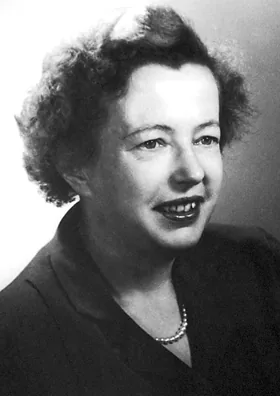
Maria Goeppert Mayer
Physicist and university teacher · Poland · 1906–1972
Birth date sourced. Birth time unknown.The Moon remained in Virgo throughout that civil day. Everything below uses only what the complete civil day settles.
The day, read honestly
Four of the ten placements whose signs are settled stand in Cancer — the Sun, Mercury, Mars and Neptune. The placements whose signs could change with an unknown hour are not counted. A cluster that size becomes the section the rest of the chart plays around.
Positions at 12:00 civil time in Katowice—a reference instant, not a birth time. No houses, rising sign, angles, or sect were computed.
Where the Sun actually stood
The Sun's position resolves to 5.8° Cancer — deep enough in the first decan (0°–10°) that the Moon, its traditional sub-ruler, colours the reading.
The fast planets
Closer in, Mercury stands at 26.0° Cancer; Venus stands at 9.2° Leo; Mars stands at 11.0° Cancer. The tradition reads thought steeped in tone and memory from Mercury, attraction declared rather than implied from Venus, effort that surges when it matters from Mars.
The angles that hold
Closest first: Jupiter to Pluto, a conjunction with 0.3° of slack. A conjunction concentrates rather than balances — the pair burns one fuel line. Behind it, the Sun opposition Uranus at 0.7°, and Mars conjunction Neptune at 1.1° — both still well inside the orbs this site uses. All of it stands whatever the hour was: each angle was tested from midnight to midnight before it was written down.
What the angles build
Mercury makes no major aspect that survives the day; the old reading gives such a planet autonomy — it acts alone, sometimes loudly.
The classical map
Read against the old dignities, two placements stand out. Mars in Cancer at 11.0° is in fall — the tradition’s uphill placement, strength earned rather than given; Jupiter in Gemini at 22.9° is in detriment — the planet opposite its home, working against the grain. None of this ranks anyone; dignity describes footing, and footing can be worked with.
The shape of the whole
Balance, counted honestly across the 10 placements whose signs hold for the whole day: elements water 5, earth 2, air 2, fire 1; modalities cardinal 5, mutable 4, fixed 1. Saturn and Uranus were retrograde — motion that reverses only from this vantage point, and which the old reading treats as delay used for revision.
The Moon, and how far it can move
The Moon stayed in Virgo for the whole of that day at the birthplace, covering 13.4° between midnight and midnight. The missing clock moves the Moon by half a sign at most here, and the boundary was never close. At the noon reference it stands at 21.2°.
Where this comes fromSources, revisions, and exactly what this chart assumes
- Source article
- Maria Goeppert Mayer · revision 1355157418
- Wikidata
- Q57100 · revision 2516771312
- Retrieved
- 2026-07-26T18:47:50.947Z
- Birth date
- 1906-06-28 · day precision · proleptic-gregorian
- Birthplace
- Katowice, Poland · Q588
- Coordinates
- 50.2500, 19.0000 · from Katowice
- Reference instant
- 1906-06-28T10:36:00.000Z · noon civil time, not a birth time
- Omitted
- Rising sign, houses, angles, and sect—all require a birth time.
- Unknown-time range
- Moon travelled 13.39° · The Moon remained in Virgo throughout that civil day.
- Engine
- astronomy-engine (repository dependency) · @zodiacs/engine/internal/math
- Portrait
- Nobel foundation · public domain · Wikimedia Commons
Something wrong here?Ask us to correct or remove it.