



People · sourced chart

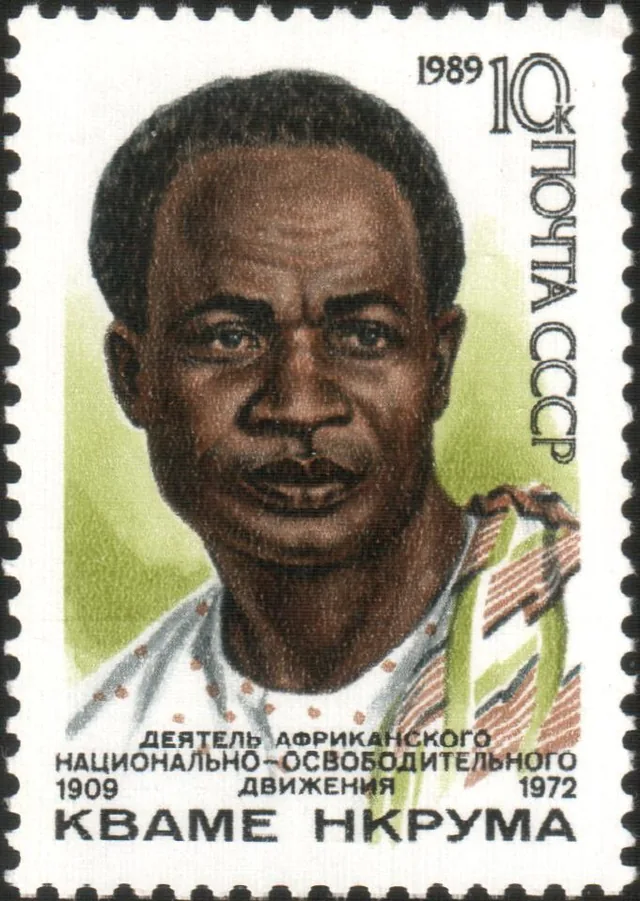
Kwame Nkrumah
Politician and writer · Ghana · 1909–1972
Birth date sourced. Birth time unknown.The Moon remained in Sagittarius throughout that civil day. Everything below uses only what the complete civil day settles.
The day, read honestly
1.0° separates the Sun and Pluto from an exact square; at that range identity and depth read as one mechanism. Right angles are where the scheme puts its grit. A square asks two functions to work in a mode neither would have chosen.
Positions at 12:00 civil time in Nkroful—a reference instant, not a birth time. No houses, rising sign, angles, or sect were computed.
Where the Sun actually stood
At noon on that date the Sun stood at 27.9° Virgo, inside the third decan (20°–30°), whose traditional sub-ruler is Venus. The decan is the older, finer division — it is what the sign looks like once you stop rounding it to thirty degrees.
The fast planets
The personal planets sit Mercury at 23.9° Libra, Venus at 5.4° Scorpio, Mars at 1.6° Aries. Mercury in a air sign reads as thought that travels by comparison; Venus in a water sign reads as attraction that works by atmosphere; Mars in a fire sign reads as effort spent in bursts and openings.
The angles that hold
The Sun and Pluto hold the closest angle here — a square, 1.0° wide. A square is friction that produces motion — the aspect the tradition credits with building capability precisely by refusing to be comfortable. Behind it, Jupiter square Pluto at 1.3°, and Uranus opposition Neptune at 1.9° — both still well inside the orbs this site uses. All of it stands whatever the hour was: each angle was tested from midnight to midnight before it was written down.
What the angles build
The Sun opposes Mars while both square Pluto. The t-square is the figure the old texts trusted for output: friction with a fixed address. The Moon makes no major aspect that survives the day; the old reading gives such a planet autonomy — it acts alone, sometimes loudly.
The classical map
Read against the old dignities, four placements stand out. Venus in Scorpio at 5.4° is in detriment — the planet opposite its home, working against the grain; Mars in Aries at 1.6° is in domicile — the planet in its own sign, running on home rules; Jupiter in Virgo at 25.6° is in detriment; Saturn in Aries at 21.4° is in fall — the tradition’s uphill placement, strength earned rather than given. None of this ranks anyone; dignity describes footing, and footing can be worked with.
The shape of the whole
Of the 10 placements whose signs hold for the whole day: 3 in earth, 3 in fire, 2 in air, 2 in water by element, 5 cardinal, 4 mutable, 1 fixed by modality. Earth signs hold the scheme’s slow end, where results are measured in what survives rather than what starts. Mars, Saturn and Uranus were retrograde — the backward drift a body appears to make as the Earth overtakes it, read in the scheme as a function that reviews before it releases.
The Moon, and how far it can move
The Moon stayed in Sagittarius for the whole of that day at the birthplace, covering 12.4° between midnight and midnight. Whatever the unrecorded hour was, it happened inside one Moon sign — the degree floats, the sign holds. At the noon reference it stands at 13.3°.
Where this comes fromSources, revisions, and exactly what this chart assumes
- Source article
- Kwame Nkrumah · revision 1365048744
- Wikidata
- Q8620 · revision 2522967114
- Retrieved
- 2026-07-26T18:47:50.947Z
- Birth date
- 1909-09-21 · day precision · proleptic-gregorian
- Birthplace
- Nkroful, Ghana · Q1994408
- Coordinates
- 4.9639, -2.3222 · from Nkroful
- Reference instant
- 1909-09-21T12:16:08.000Z · noon civil time, not a birth time
- Omitted
- Rising sign, houses, angles, and sect—all require a birth time.
- Unknown-time range
- Moon travelled 12.36° · The Moon remained in Sagittarius throughout that civil day.
- Engine
- astronomy-engine (repository dependency) · @zodiacs/engine/internal/math
- Portrait
- USSR Post · public domain · Wikimedia Commons
Something wrong here?Ask us to correct or remove it.