



People · sourced chart

Kathleen Kenyon
Archaeologist · United Kingdom · 1906–1978
Birth date sourced. Birth time unknown.The Moon remained in Taurus throughout that civil day. Everything below uses only what the complete civil day settles.
The day, read honestly
The Moon stands at 15.6° Taurus, in exaltation — the tradition’s honoured-guest placement, working at its best. Of everything the chart can be read for without a birth time, that is the loudest single fact in it.
Positions at 12:00 civil time in London—a reference instant, not a birth time. No houses, rising sign, angles, or sect were computed.
Where the Sun actually stood
Measured rather than labelled, the Sun holds 14.3° Capricorn: the second decan, whose classical sub-ruler is Venus. A earth sign, read here in its second face.
Closer to the ground
Day to day the chart speaks through Mercury in Sagittarius (21.3°), Venus in Capricorn (4.7°), Mars in Pisces (6.8°): a mind that decides at speaking speed, taste for the substantial and the lasting, drive that moves on certainty and current.
The angles that hold
Mercury to Pluto is the closest call of the day, a opposition within 0.0°. An opposition is the tradition’s tug of war. Both ends are real, and the work is holding them at once rather than picking a winner. Behind it, Venus conjunction Uranus at 0.3°, and Mars sextile Uranus at 1.9° — both still well inside the orbs this site uses. Each angle here was measured at every hour of the civil day and held; whatever the missing clock said, this geometry was in it.
The standing structure
The day-stable angles form no closed figure. Nothing funnels; each aspect is its own negotiation, which the tradition reads as a chart of separate treaties rather than one campaign.
The classical map
Three planets here sit in a sign the classical scheme scores. The Moon in Taurus at 15.6° is in exaltation — the tradition’s honoured-guest placement, working at its best; Mercury in Sagittarius at 21.3° is in detriment — the planet opposite its home, working against the grain; Saturn in Aquarius at 29.7° is in domicile — the planet in its own sign, running on home rules. Condition, not character: that is all the dignity table ever measured.
The shape of the whole
The honest balance sheet uses the 10 placements whose signs hold for the whole day: earth 5, water 2, air 2, fire 1 across the elements, and cardinal 4, fixed 3, mutable 3 across the modalities. An earth emphasis reads as patience with material reality — slow hands, durable results. Jupiter, Neptune and Pluto were retrograde — motion that reverses only from this vantage point, and which the old reading treats as delay used for revision.
The Moon, and how far it can move
The Moon stayed in Taurus for the whole of that day at the birthplace, covering 11.9° between midnight and midnight. The sign survives the missing hour; the degree does not, and is given as a reference rather than a fact. At the noon reference it stands at 15.6°.
Where this comes fromSources, revisions, and exactly what this chart assumes
- Source article
- Kathleen Kenyon · revision 1356309339
- Wikidata
- Q238890 · revision 2520904738
- Retrieved
- 2026-07-26T18:47:50.947Z
- Birth date
- 1906-01-05 · day precision · proleptic-gregorian
- Birthplace
- London, United Kingdom · Q84
- Coordinates
- 51.5072, -0.1275 · from London
- Reference instant
- 1906-01-05T12:00:00.000Z · noon civil time, not a birth time
- Omitted
- Rising sign, houses, angles, and sect—all require a birth time.
- Unknown-time range
- Moon travelled 11.91° · The Moon remained in Taurus throughout that civil day.
- Engine
- astronomy-engine (repository dependency) · @zodiacs/engine/internal/math
- Portrait
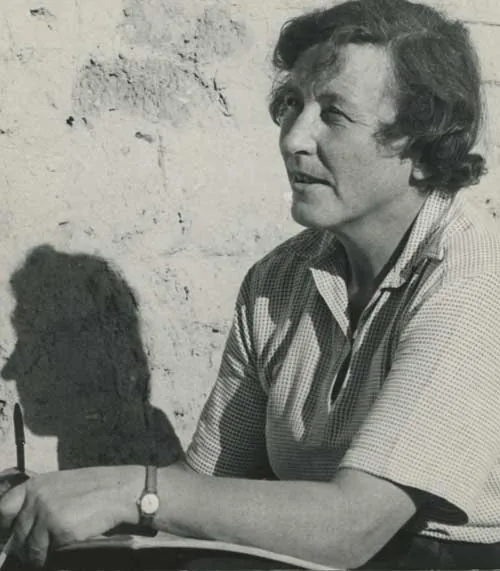
- UCL Institute of Archaeology · CC BY 4.0 · Wikimedia Commons
Something wrong here?Ask us to correct or remove it.