



People · sourced chart

Jules Verne
Novelist · France · 1828–1905
Birth date sourced. Birth time unknown.The Moon remained in Scorpio throughout that civil day. Everything below uses only what the complete civil day settles.
The day, read honestly
Across the ten placements whose signs are settled, fixed leads with four. The fixed signs are the scheme’s ballast — mid-season, fully committed, expensive to turn.
Positions at 12:00 civil time in Nantes—a reference instant, not a birth time. No houses, rising sign, angles, or sect were computed.
Where the Sun actually stood
At noon on that date the Sun stood at 18.8° Aquarius, inside the second decan (10°–20°), whose traditional sub-ruler is Mercury. The decan is the older, finer division — it is what the sign looks like once you stop rounding it to thirty degrees.
The fast planets
Closer in, Mercury stands at 22.7° Aquarius; Venus stands at 18.3° Pisces; Mars stands at 0.5° Sagittarius. The tradition reads thought that travels by comparison from Mercury, attraction that works by atmosphere from Venus, effort spent in bursts and openings from Mars.
The angles that hold
The day's firmest angle joins Jupiter and Saturn — a trine holding at 0.7°. A trine runs downhill — the talent that never announces itself because it never had to. Behind it, Mars sextile Uranus at 1.1°, and Venus sextile Neptune at 1.3° — both still well inside the orbs this site uses. The unknown hour cannot unmake any of this: every aspect named survived all twenty-five samples of the day.
The standing structure
Venus, Jupiter, Saturn close a triangle of trines. A grand trine is read as self-sufficiency in one element: the current circulates whether or not anything is asked of it.
The classical map
The oldest layer of the scheme — seven planets, four conditions — flags four placements in this chart. The Sun in Aquarius at 18.8° is in detriment — the planet opposite its home, working against the grain; the Moon in Scorpio at 14.4° is in fall — the tradition’s uphill placement, strength earned rather than given; Venus in Pisces at 18.3° is in exaltation — the tradition’s honoured-guest placement, working at its best; Saturn in Cancer at 14.4° is in detriment. None of this ranks anyone; dignity describes footing, and footing can be worked with.
The shape of the whole
Balance, counted honestly across the 10 placements whose signs hold for the whole day: elements water 4, air 2, fire 2, earth 2; modalities fixed 4, cardinal 4, mutable 2. A water emphasis keeps long books: little is forgotten, and nothing is felt only once. Saturn was retrograde — the optical reversal the tradition reads as review — energy turned over before it is turned out.
The Moon, and how far it can move
The Moon stayed in Scorpio for the whole of that day at the birthplace, covering 13.4° between midnight and midnight. Whatever the unrecorded hour was, it happened inside one Moon sign — the degree floats, the sign holds. At the noon reference it stands at 14.4°.
Where this comes fromSources, revisions, and exactly what this chart assumes
- Source article
- Jules Verne · revision 1361353063
- Wikidata
- Q33977 · revision 2522581853
- Retrieved
- 2026-07-26T18:47:50.947Z
- Birth date
- 1828-02-08 · day precision · proleptic-gregorian
- Birthplace
- Nantes, France · Q12191
- Coordinates
- 47.2172, -1.5539 · from Nantes
- Reference instant
- 1828-02-08T11:50:39.000Z · noon civil time, not a birth time
- Omitted
- Rising sign, houses, angles, and sect—all require a birth time.
- Unknown-time range
- Moon travelled 13.42° · The Moon remained in Scorpio throughout that civil day.
- Engine
- astronomy-engine (repository dependency) · @zodiacs/engine/internal/math
- Portrait
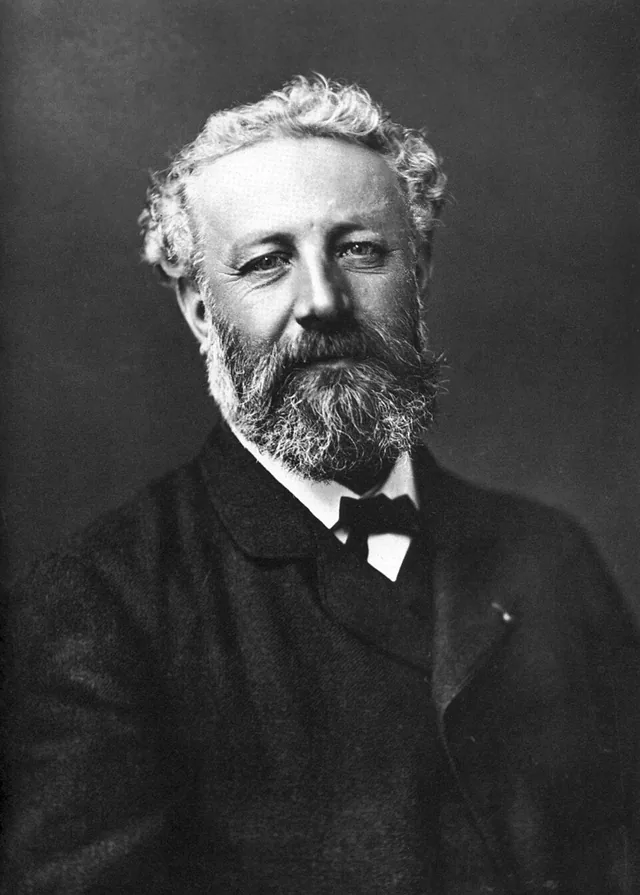
- Nadar · public domain · Wikimedia Commons
Something wrong here?Ask us to correct or remove it.