



People · sourced chart

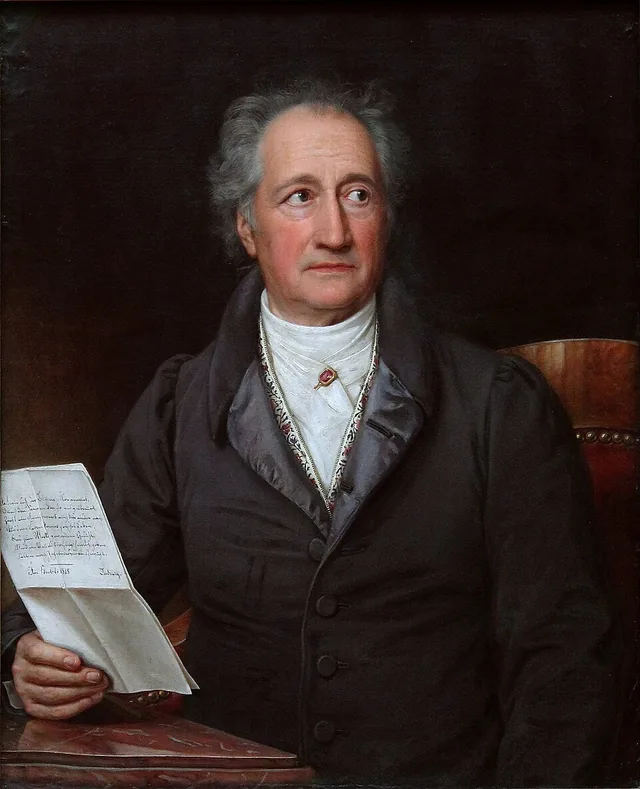
Johann Wolfgang von Goethe
Botanist and politician · Germany · 1749–1832
Birth date sourced. Birth time unknown.The Moon remained in Pisces throughout that civil day. Everything below uses only what the complete civil day settles.
The day, read honestly
The chart's headline is a sextile: Venus and Neptune within 0.2°, taste wired to imagination. The scheme reads a sextile as a door left unlocked. Useful, and entirely dependent on someone walking through it.
Positions at 12:00 civil time in Frankfurt—a reference instant, not a birth time. No houses, rising sign, angles, or sect were computed.
Where the Sun actually stood
Measured rather than labelled, the Sun holds 5.2° Virgo: the first decan, whose classical sub-ruler is Mercury. A earth sign, read here in its first face.
The personal registers
For the fast movers, Mercury was at 25.9° Leo, Venus was at 26.4° Virgo, Mars was at 3.5° Capricorn. Read together: a mind that decides at speaking speed; taste for the substantial and the lasting; drive that grinds rather than flares.
The angles that hold
Start where the chart is tightest — Venus sextile Neptune, 0.2° of separation. A sixth of the circle is close enough for cooperation and far enough that it stays optional. Behind it, Venus opposition Jupiter at 0.4°, and Jupiter trine Neptune at 0.6° — both still well inside the orbs this site uses. Each angle here was measured at every hour of the civil day and held; whatever the missing clock said, this geometry was in it.
Figures in the geometry
Jupiter, Neptune, Pluto close a triangle of trines. The closed triangle is the scheme’s picture of flow — and its warning that flow, unspent, stays private. The Moon stands apart from every major angle the day held — the tradition reads an unaspected planet as a voice that speaks on its own schedule, unmodulated by the rest of the chart.
The classical map
Of the seven planets the classical scheme judges, three sit in a sign it has an opinion about. Venus in Virgo at 26.4° is in fall — the tradition’s uphill placement, strength earned rather than given; Mars in Capricorn at 3.5° is in exaltation — the tradition’s honoured-guest placement, working at its best; Jupiter in Pisces at 26.0° is in domicile — the planet in its own sign, running on home rules. Condition, not character: that is all the dignity table ever measured.
The shape of the whole
Tallied where the signs are certain — 10 placements whose signs hold for the whole day — the chart gives water 5, earth 3, fire 1, air 1, and mutable 4, fixed 4, cardinal 2 across the modes. Water signs hold memory in the scheme, where nothing is quite finished and little is genuinely forgotten. Jupiter and Uranus were retrograde — the optical reversal the tradition reads as review — energy turned over before it is turned out.
The Moon, and how far it can move
The Moon stayed in Pisces for the whole of that day at the birthplace, covering 15.3° between midnight and midnight. Whatever the unrecorded hour was, it happened inside one Moon sign — the degree floats, the sign holds. At the noon reference it stands at 11.7°.
Where this comes fromSources, revisions, and exactly what this chart assumes
- Source article
- Johann Wolfgang von Goethe · revision 1364930893
- Wikidata
- Q5879 · revision 2522462854
- Retrieved
- 2026-07-26T18:47:50.947Z
- Birth date
- 1749-08-28 · day precision · proleptic-gregorian
- Birthplace
- Frankfurt, Germany · Q1794
- Coordinates
- 50.1106, 8.6822 · from Frankfurt
- Reference instant
- 1749-08-28T11:06:32.000Z · noon civil time, not a birth time
- Omitted
- Rising sign, houses, angles, and sect—all require a birth time.
- Unknown-time range
- Moon travelled 15.29° · The Moon remained in Pisces throughout that civil day.
- Engine
- astronomy-engine (repository dependency) · @zodiacs/engine/internal/math
- Portrait
- Joseph Karl Stieler · public domain · Wikimedia Commons
Something wrong here?Ask us to correct or remove it.