



People · sourced chart

Jean-Jacques Rousseau
Philosopher and pedagogue · Switzerland · 1712–1778
Birth date sourced. Birth time unknown.The Moon remained in Taurus throughout that civil day. Everything below uses only what the complete civil day settles.
The day, read honestly
The Moon stands at 7.0° Taurus, in exaltation — the tradition’s honoured-guest placement, working at its best. Of everything the chart can be read for without a birth time, that is the loudest single fact in it.
Positions at 12:00 civil time in Geneva—a reference instant, not a birth time. No houses, rising sign, angles, or sect were computed.
Where the Sun actually stood
Measured rather than labelled, the Sun holds 6.7° Cancer: the first decan, whose classical sub-ruler is the Moon. A water sign, read here in its first face.
The personal registers
Closer in, Mercury stands at 15.5° Gemini; Venus stands at 19.9° Gemini; Mars stands at 10.3° Gemini. The tradition reads a mind at home in argument and pattern from Mercury, taste led by wit and proportion from Venus, drive that argues its way forward from Mars.
The angles that hold
The day's firmest angle joins Uranus and Neptune — a trine holding at 0.5°. Trines are read as inheritance rather than achievement: the ease is genuine, and nothing about it was earned. Behind it, Jupiter square Neptune at 1.2°, and Mars sextile Saturn at 2.2° — both still well inside the orbs this site uses. These are the day-proof angles — present at midnight, present at noon, present at the next midnight.
What the angles build
The day-stable angles form no closed figure. Nothing funnels; each aspect is its own negotiation, which the tradition reads as a chart of separate treaties rather than one campaign.
The classical map
Three planets here sit in a sign the classical scheme scores. The Moon in Taurus at 7.0° is in exaltation — the tradition’s honoured-guest placement, working at its best; Mercury in Gemini at 15.5° is in domicile — the planet in its own sign, running on home rules; Saturn in Leo at 12.5° is in detriment — the planet opposite its home, working against the grain. Condition, not character: that is all the dignity table ever measured.
The shape of the whole
The certain ground: 10 placements whose signs hold for the whole day, dividing 4 earth, 4 air, 1 water, 1 fire by element and 5 mutable, 4 fixed, 1 cardinal by mode. Earth weights a chart toward the material and the durable — what can be built, kept, and relied on. Jupiter was retrograde — apparent backward motion from where the Earth sits, which the tradition reads as a function turned inward before it is turned out.
The Moon, and how far it can move
The Moon stayed in Taurus for the whole of that day at the birthplace, covering 12.1° between midnight and midnight. The sign survives the missing hour; the degree does not, and is given as a reference rather than a fact. At the noon reference it stands at 7.0°.
Where this comes fromSources, revisions, and exactly what this chart assumes
- Source article
- Jean-Jacques Rousseau · revision 1364272815
- Wikidata
- Q6527 · revision 2522756075
- Retrieved
- 2026-07-26T18:47:50.947Z
- Birth date
- 1712-06-28 · day precision · proleptic-gregorian
- Birthplace
- Geneva, Switzerland · Q71
- Coordinates
- 46.2000, 6.1500 · from Geneva
- Reference instant
- 1712-06-28T11:25:52.000Z · noon civil time, not a birth time
- Omitted
- Rising sign, houses, angles, and sect—all require a birth time.
- Unknown-time range
- Moon travelled 12.14° · The Moon remained in Taurus throughout that civil day.
- Engine
- astronomy-engine (repository dependency) · @zodiacs/engine/internal/math
- Portrait
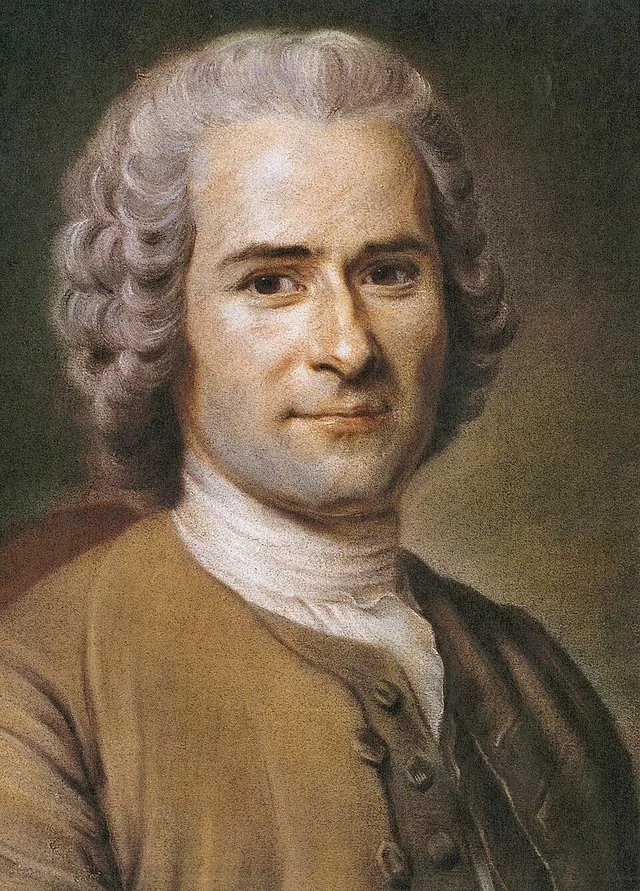
- Maurice Quentin de La Tour · public domain · Wikimedia Commons
Something wrong here?Ask us to correct or remove it.