


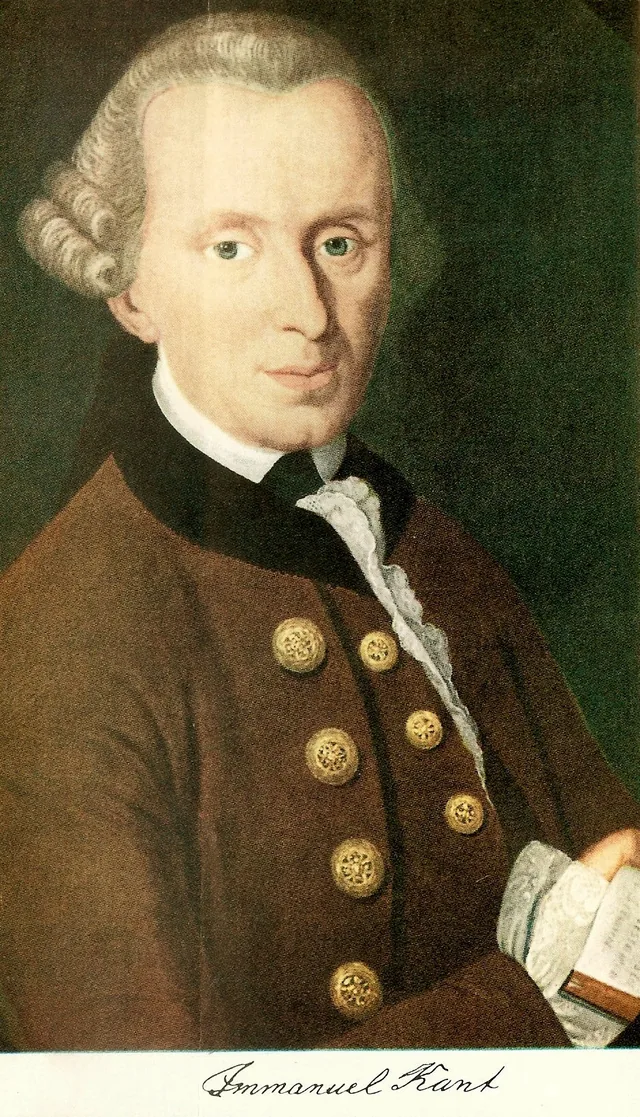


Immanuel Kant
Philosopher · Prussia · 1724–1804
Birth date sourced. Birth time unknown.
The Moon remained in Aries throughout that civil day. Everything below uses only what the complete civil day settles.The Sun and Uranus sit 0.5° from an exact opposition — near enough that the tradition reads identity and disruption as a single working part. The scheme reads an opposition as an axis to walk, not a fight to win: the chart keeps both ends lit.
Positions at 12:00 civil time in Königsberg, a reference instant, not a birth time. No houses, rising sign, angles, or sect were computed.
Where the Sun actually stood
The Sun's exact place is 2.4° Taurus. That falls in the first decan, 0°–10°, sub-ruled by Venus in the classical scheme — an earth sign read through a fixed season.
The fast planets
For the fast movers, Mercury was at 20.9° Aries, Venus was at 10.8° Gemini, Mars was at 19.1° Cancer. Read together: a mind that decides at speaking speed; taste led by wit and proportion; drive that moves on certainty and current.
The angles that hold
The day's firmest angle joins the Sun and Uranus — an opposition holding at 0.5°. Oppositions are read as full-moon geometry — maximum visibility between two needs that share one spine. Behind it, Venus trine Jupiter at 0.8°, and Mercury square Mars at 1.7° — both still well inside the orbs this site uses. These angles were checked through every hour of that civil day and survive throughout, which is why an unrecorded hour does not disturb them.
What the angles build
Saturn stands apart from every major angle the day held — the tradition reads an unaspected planet as a voice that speaks on its own schedule, unmodulated by the rest of the chart.
The classical map
Two planets here sit in a sign the classical scheme scores. Mars in Cancer at 19.1° is in fall — the tradition’s uphill placement, strength earned rather than given; Saturn in Capricorn at 10.8° is in domicile — the planet in its own sign, running on home rules. The old table grades terrain, not talent — a placement in fall works uphill, nothing more.
The shape of the whole
Balance, counted honestly across the 10 placements whose signs hold for the whole day: elements earth 4, fire 2, air 2, water 2; modalities fixed 4, cardinal 4, mutable 2. Saturn, Uranus and Pluto were retrograde — motion that reverses only from this vantage point, and which the old reading treats as delay used for revision.
The Moon, and how far it can move
The Moon stayed in Aries for the whole of that day at the birthplace, covering 15.2° between midnight and midnight. The missing clock moves the Moon by half a sign at most here, and the boundary was never close. At the noon reference it stands at 18.9°.
Where this comes fromSources, revisions, and exactly what this chart assumes
- Source article
- Immanuel Kant · revision 1362779413
- Wikidata
- Q9312 · revision 2522333072
- Retrieved
- 2026-07-26T18:47:50.947Z
- Birth date
- 1724-04-22 · day precision · proleptic-gregorian
- Birthplace
- Königsberg, Prussia · Q4120832
- Coordinates
- 54.7115, 20.5093 · from Königsberg (Q4120832)
- Birth-time evidence in this profile
- none — Wikidata carries no birth-time claim for this person
- Reference instant
- 1724-04-22T10:37:58.000Z · noon civil time, not a birth time
- Omitted
- Rising sign, houses, angles, and sect. All require a birth time.
- Unknown-time range
- Moon travelled 15.20° · The Moon remained in Aries throughout that civil day.
- Engine
- astronomy-engine (repository dependency) · @zodiacs/engine/internal/math
- Portrait
- Becker · public domain · Wikimedia Commons
Something wrong here? Ask us to correct or remove it.