



People · sourced chart

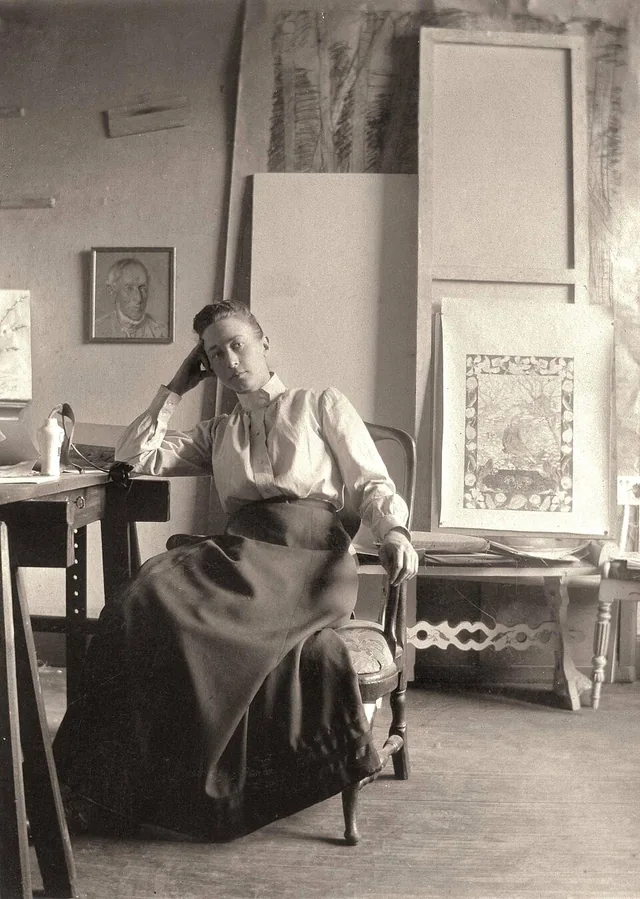
Hilma af Klint
Artist · Sweden · 1862–1944
Birth date sourced. Birth time unknown.The Moon remained in Sagittarius throughout that civil day. Everything below uses only what the complete civil day settles.
The day, read honestly
Across the ten placements whose signs are settled, cardinal leads with five. The four cardinal signs sit at the solstices and equinoxes — the scheme’s ignition points, and this chart is weighted to them.
Positions at 12:00 civil time in Solna Municipality—a reference instant, not a birth time. No houses, rising sign, angles, or sect were computed.
Where the Sun actually stood
The Sun's position resolves to 2.8° Scorpio — deep enough in the first decan (0°–10°) that Mars, its traditional sub-ruler, colours the reading.
The fast planets
The personal planets sit Mercury at 5.1° Scorpio, Venus at 21.6° Libra, Mars at 7.6° Aries. Mercury in a water sign reads as thought steeped in tone and memory; Venus in a air sign reads as attraction that begins as conversation; Mars in a fire sign reads as effort spent in bursts and openings.
The angles that hold
Nothing in the geometry sits closer than Venus and Uranus: 1.2° from an exact trine. A trine is an open channel. The two cooperate without being asked, which is exactly why it is easy to spend and easy to take for granted. Behind it, Saturn opposition Neptune at 1.3°, and the Sun conjunction Mercury at 2.3° — both still well inside the orbs this site uses. The unknown hour cannot unmake any of this: every aspect named survived all twenty-five samples of the day.
What the angles build
The Moon makes no major aspect that survives the day; the old reading gives such a planet autonomy — it acts alone, sometimes loudly.
The classical map
The oldest layer of the scheme — seven planets, four conditions — flags three placements in this chart. Venus in Libra at 21.6° is in domicile — the planet in its own sign, running on home rules; Mars in Aries at 7.6° is in domicile; Saturn in Libra at 0.4° is in exaltation — the tradition’s honoured-guest placement, working at its best. The table describes circumstance rather than quality — a planet in detriment is inconvenienced, not diminished.
The shape of the whole
The honest balance sheet uses the 10 placements whose signs hold for the whole day: air 4, fire 3, water 2, earth 1 across the elements, and cardinal 5, fixed 3, mutable 2 across the modalities. An air-weighted chart thinks in through-lines; the sentence is how it takes hold of the world. Mercury, Mars, Uranus, Neptune and Pluto were retrograde — apparent backward motion from where the Earth sits, which the tradition reads as a function turned inward before it is turned out.
The Moon, and how far it can move
The Moon stayed in Sagittarius for the whole of that day at the birthplace, covering 14.7° between midnight and midnight. The sign survives the missing hour; the degree does not, and is given as a reference rather than a fact. At the noon reference it stands at 16.0°.
Where this comes fromSources, revisions, and exactly what this chart assumes
- Source article
- Hilma af Klint · revision 1361374246
- Wikidata
- Q436267 · revision 2518527893
- Retrieved
- 2026-07-26T18:47:50.947Z
- Birth date
- 1862-10-26 · day precision · proleptic-gregorian
- Birthplace
- Solna Municipality, Sweden · Q109010
- Coordinates
- 59.3667, 18.0167 · from Solna Municipality
- Reference instant
- 1862-10-26T11:06:32.000Z · noon civil time, not a birth time
- Omitted
- Rising sign, houses, angles, and sect—all require a birth time.
- Unknown-time range
- Moon travelled 14.66° · The Moon remained in Sagittarius throughout that civil day.
- Engine
- astronomy-engine (repository dependency) · @zodiacs/engine/internal/math
- Portrait
- AnonymousUnknown author · public domain · Wikimedia Commons
Something wrong here?Ask us to correct or remove it.