



People · sourced chart

Hans Christian Andersen
Writer · Denmark · 1805–1875
Birth date sourced. Birth time unknown.The Moon remained in Taurus throughout that civil day. Everything below uses only what the complete civil day settles.
The day, read honestly
The Sun stands at 12.3° Aries, in exaltation — the tradition’s honoured-guest placement, working at its best. Of everything the chart can be read for without a birth time, that is the loudest single fact in it.
Positions at 12:00 civil time in Odense—a reference instant, not a birth time. No houses, rising sign, angles, or sect were computed.
Where the Sun actually stood
Aries, but precisely: 12.3°, second decan, 10°–20°, under the Sun in the triplicity scheme. The tradition kept these divisions because thirty degrees is a long street.
The personal registers
Closer in, Mercury stands at 14.1° Aries; Venus stands at 27.8° Pisces; Mars stands at 2.5° Leo. The tradition reads a mind that decides at speaking speed from Mercury, taste tuned to mood and undertow from Venus, drive that ignites on contact from Mars.
The angles that hold
Venus and Neptune hold the closest angle here — a trine, 0.1° wide. A trine is an open channel. The two cooperate without being asked, which is exactly why it is easy to spend and easy to take for granted. Behind it, the Sun opposition Saturn at 0.6°, and Mercury opposition Saturn at 1.3° — both still well inside the orbs this site uses. These are the day-proof angles — present at midnight, present at noon, present at the next midnight.
What the angles build
Venus, Mars, Neptune close a triangle of trines. A grand trine is read as self-sufficiency in one element: the current circulates whether or not anything is asked of it. The Moon stands apart from every major angle the day held — the tradition reads an unaspected planet as a voice that speaks on its own schedule, unmodulated by the rest of the chart.
The classical map
The classical table has five entries for this chart. The Sun in Aries at 12.3° is in exaltation — the tradition’s honoured-guest placement, working at its best; the Moon in Taurus at 15.8° is in exaltation; Venus in Pisces at 27.8° is in exaltation; Jupiter in Sagittarius at 6.2° is in domicile — the planet in its own sign, running on home rules; Saturn in Libra at 12.9° is in exaltation. Condition, not character: that is all the dignity table ever measured.
The shape of the whole
The certain ground: 10 placements whose signs hold for the whole day, dividing 4 fire, 3 water, 2 air, 1 earth by element and 4 cardinal, 3 fixed, 3 mutable by mode. Jupiter, Saturn, Uranus and Neptune were retrograde — motion that reverses only from this vantage point, and which the old reading treats as delay used for revision.
The Moon, and how far it can move
The Moon stayed in Taurus for the whole of that day at the birthplace, covering 14.5° between midnight and midnight. That is quick enough to make the exact degree a neighbourhood rather than an address, and slow enough to leave the sign settled. At the noon reference it stands at 15.8°.
Where this comes fromSources, revisions, and exactly what this chart assumes
- Source article
- Hans Christian Andersen · revision 1364936125
- Wikidata
- Q5673 · revision 2522566504
- Retrieved
- 2026-07-26T18:47:50.947Z
- Birth date
- 1805-04-02 · day precision · proleptic-gregorian
- Birthplace
- Odense, Denmark · Q25331
- Coordinates
- 55.4000, 10.3833 · from Odense
- Reference instant
- 1805-04-02T11:06:32.000Z · noon civil time, not a birth time
- Omitted
- Rising sign, houses, angles, and sect—all require a birth time.
- Unknown-time range
- Moon travelled 14.52° · The Moon remained in Taurus throughout that civil day.
- Engine
- astronomy-engine (repository dependency) · @zodiacs/engine/internal/math
- Portrait
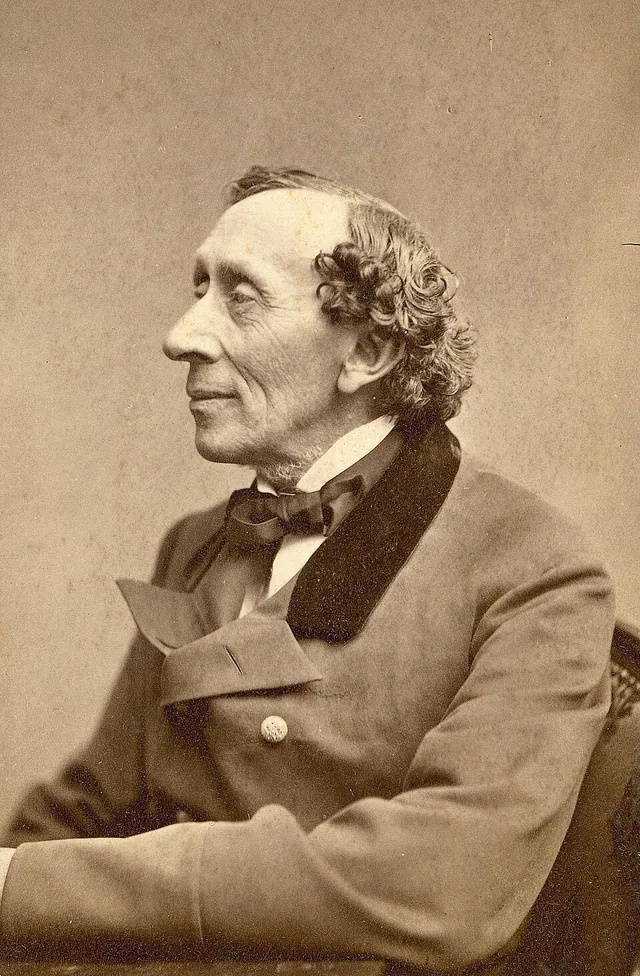
- Thora Hallager · public domain · Wikimedia Commons
Something wrong here?Ask us to correct or remove it.