



People · sourced chart

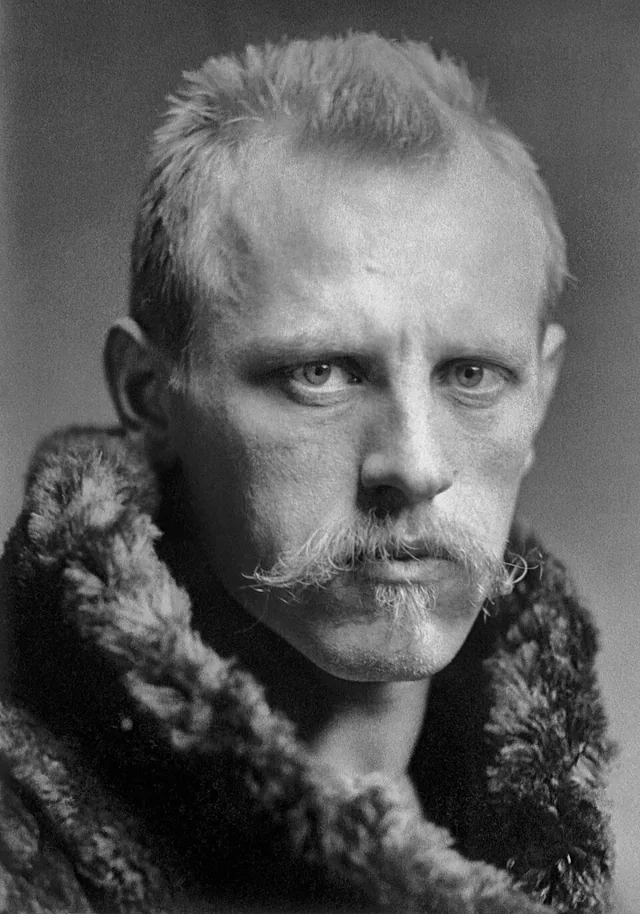
Fridtjof Nansen
Zoologist and polar explorer · Norway · 1861–1930
Birth date sourced. Birth time unknown.The Moon remained in Capricorn throughout that civil day. Everything below uses only what the complete civil day settles.
The day, read honestly
Tightest of all, Mercury holds a opposition to Pluto at 0.5° — close enough to weld thinking to depth. An opposition is the tradition’s tug of war. Both ends are real, and the work is holding them at once rather than picking a winner.
Positions at 12:00 civil time in Vestre Aker—a reference instant, not a birth time. No houses, rising sign, angles, or sect were computed.
Where the Sun actually stood
At the noon reference the Sun sits 17.1° into Libra — the second decan, which the old scheme hands to Saturn. Same sign, different decan, different chart.
The fast planets
Mercury holds 9.3° Scorpio, Venus holds 25.9° Scorpio, Mars holds 2.2° Libra — in the old shorthand, thought steeped in tone and memory; attraction that works by atmosphere; effort aimed through strategy and words.
The angles that hold
The day's firmest angle joins Jupiter and Uranus — a square holding at 0.0°. Nothing in a square flows; everything in it works. The old texts kept squares for the charts they respected. Behind it, Mercury opposition Pluto at 0.5°, and the Sun trine Uranus at 0.9° — both still well inside the orbs this site uses. All of it stands whatever the hour was: each angle was tested from midnight to midnight before it was written down.
Figures in the geometry
The Moon makes no major aspect that survives the day; the old reading gives such a planet autonomy — it acts alone, sometimes loudly.
The classical map
The dignity table, which predates the outer planets and only ever spoke for seven, marks five placements here. The Sun in Libra at 17.1° is in fall — the tradition’s uphill placement, strength earned rather than given; the Moon in Capricorn at 11.4° is in detriment — the planet opposite its home, working against the grain; Venus in Scorpio at 25.9° is in detriment; Mars in Libra at 2.2° is in detriment; Jupiter in Virgo at 16.2° is in detriment. The table describes circumstance rather than quality — a planet in detriment is inconvenienced, not diminished.
The shape of the whole
Counting only the 10 placements whose signs hold for the whole day, the chart runs 4 earth, 3 air, 3 water by element and 4 mutable, 3 cardinal, 3 fixed by modality. Earth counts what remains: the built, the kept, the finished. Promise weighs less than delivery. No settled placement falls in fire — an absence the tradition treats as information, not as a defect. Uranus, Neptune and Pluto were retrograde — motion that reverses only from this vantage point, and which the old reading treats as delay used for revision.
The Moon, and how far it can move
The Moon stayed in Capricorn for the whole of that day at the birthplace, covering 13.6° between midnight and midnight. That is quick enough to make the exact degree a neighbourhood rather than an address, and slow enough to leave the sign settled. At the noon reference it stands at 11.4°.
Where this comes fromSources, revisions, and exactly what this chart assumes
- Source article
- Fridtjof Nansen · revision 1365695508
- Wikidata
- Q72292 · revision 2517723972
- Retrieved
- 2026-07-26T18:47:50.947Z
- Birth date
- 1861-10-10 · day precision · proleptic-gregorian
- Birthplace
- Vestre Aker, Norway · Q606860
- Coordinates
- 59.9500, 10.6722 · from Vestre Aker
- Reference instant
- 1861-10-10T11:06:32.000Z · noon civil time, not a birth time
- Omitted
- Rising sign, houses, angles, and sect—all require a birth time.
- Unknown-time range
- Moon travelled 13.56° · The Moon remained in Capricorn throughout that civil day.
- Engine
- astronomy-engine (repository dependency) · @zodiacs/engine/internal/math
- Portrait
- Henry Van der Weyde · public domain · Wikimedia Commons
Something wrong here?Ask us to correct or remove it.