


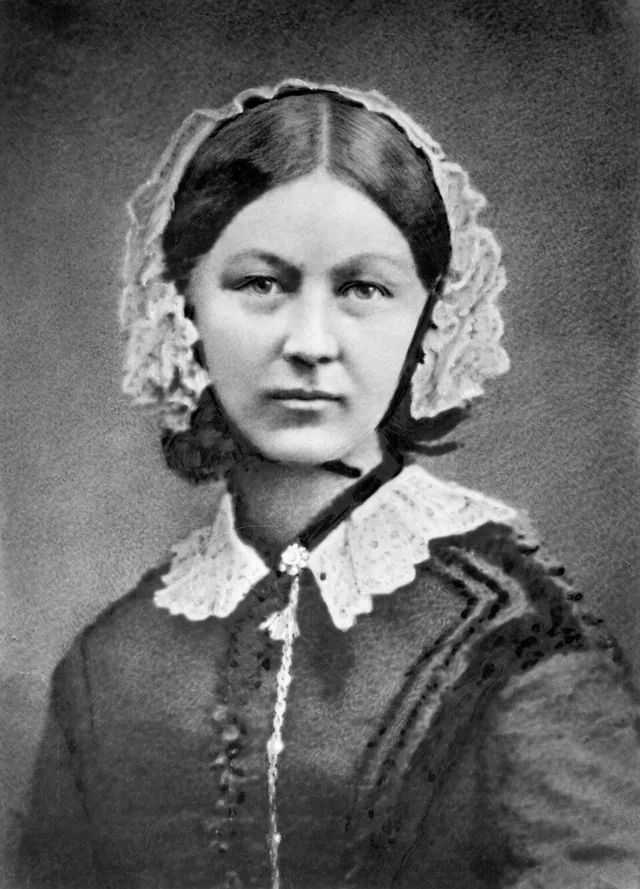


Florence Nightingale
Nurse and writer · Italy · 1820–1910
Birth date sourced. Birth time unknown.
The Moon remained in Taurus throughout that civil day. Everything below uses only what the complete civil day settles.The Moon stands at 22.8° Taurus, in exaltation — the tradition’s honoured-guest placement, working at its best. Of everything the chart can be read for without a birth time, that is the loudest single fact in it.
Positions at 12:00 civil time in Florence, a reference instant, not a birth time. No houses, rising sign, angles, or sect were computed.
Where the Sun actually stood
The Sun's exact place is 21.6° Taurus. That falls in the third decan, 20°–30°, sub-ruled by Saturn in the classical scheme — an earth sign read through a fixed season.
The personal registers
For the fast movers, Mercury was at 25.7° Aries, Venus was at 6.7° Cancer, Mars was at 10.5° Leo. Read together: a mind that decides at speaking speed; taste tuned to mood and undertow; drive that ignites on contact.
The angles that hold
Start where the chart is tightest — Uranus square Pluto, 0.1° of separation. A square is friction that produces motion — the aspect the tradition credits with building capability precisely by refusing to be comfortable. Behind it, Mars trine Saturn at 1.2°, and Neptune square Pluto at 2.1° — both still well inside the orbs this site uses. These are the day-proof angles — present at midnight, present at noon, present at the next midnight.
Figures in the geometry
The day-stable angles form no closed figure. Nothing funnels; each aspect is its own negotiation, which the tradition reads as a chart of separate treaties rather than one campaign.
The classical map
Three planets here sit in a sign the classical scheme scores. The Moon in Taurus at 22.8° is in exaltation — the tradition’s honoured-guest placement, working at its best; Jupiter in Pisces at 17.7° is in domicile — the planet in its own sign, running on home rules; Saturn in Aries at 9.3° is in fall — the tradition’s uphill placement, strength earned rather than given. None of these labels is a verdict on a person; they describe how a function is situated, nothing more.
The shape of the whole
Of the 10 placements whose signs hold for the whole day: 4 in fire, 3 in earth, 3 in water by element, 4 cardinal, 3 fixed, 3 mutable by modality. A fire-weighted chart runs hot at the start line — initiative is its native language. No settled placement falls in air — an absence the tradition treats as information, not as a defect. Uranus and Neptune were retrograde — the optical reversal the tradition reads as review — energy turned over before it is turned out.
The Moon, and how far it can move
The Moon stayed in Taurus for the whole of that day at the birthplace, covering 13.8° between midnight and midnight. The missing clock moves the Moon by half a sign at most here, and the boundary was never close. At the noon reference it stands at 22.8°.
Where this comes fromSources, revisions, and exactly what this chart assumes
- Source article
- Florence Nightingale · revision 1358730807
- Wikidata
- Q37103 · revision 2519329548
- Retrieved
- 2026-07-26T18:47:50.947Z
- Birth date
- 1820-05-12 · day precision · proleptic-gregorian
- Birthplace
- Florence, Italy · Q2044
- Coordinates
- 43.7714, 11.2542 · from Florence (Q2044)
- Birth-time evidence in this profile
- none — Wikidata carries no birth-time claim for this person
- Reference instant
- 1820-05-12T11:14:59.000Z · noon civil time, not a birth time
- Omitted
- Rising sign, houses, angles, and sect. All require a birth time.
- Unknown-time range
- Moon travelled 13.81° · The Moon remained in Taurus throughout that civil day.
- Engine
- astronomy-engine (repository dependency) · @zodiacs/engine/internal/math
- Portrait
- Henry Hering (1814-1893) · public domain · Wikimedia Commons
Something wrong here? Ask us to correct or remove it.