



People · sourced chart

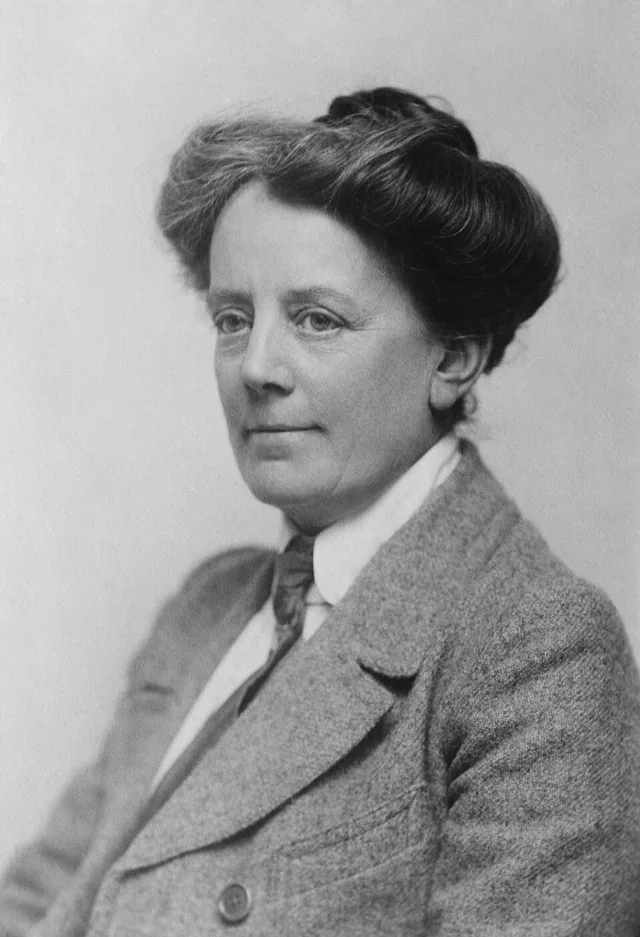
Ethel Smyth
Composer and autobiographer · United Kingdom · 1858–1944
Birth date sourced. Birth time unknown.Moon sign undetermined. The Moon crossed from Leo into Virgo during that day. Everything below uses only what the complete civil day settles.
The day, read honestly
Six of the nine placements whose signs are settled stand in Taurus — the Sun, Mercury, Venus, Jupiter, Uranus and Pluto. The placements whose signs could change with an unknown hour are not counted. A cluster that size becomes the section the rest of the chart plays around.
Positions at 12:00 civil time in Sidcup—a reference instant, not a birth time. No houses, rising sign, angles, or sect were computed.
Where the Sun actually stood
2.0° of Taurus is the Sun's exact seat — first decan, 0°–10°, sub-ruled by Venus in the old triplicity scheme. The degree is the address; the sign is only the street.
The personal registers
For the fast movers, Mercury was at 21.9° Taurus, Venus was at 15.4° Taurus, Mars was at 1.3° Sagittarius. Read together: thought with its feet on the ground; attraction that grows by reliability; effort spent in bursts and openings.
The angles that hold
Nothing in the geometry sits closer than Jupiter and Saturn: 0.0° from an exact sextile. A sextile is an offer rather than a given: available when it is reached for, quiet when it is not. Behind it, Mercury sextile Saturn at 0.4°, and Mercury conjunction Jupiter at 0.4° — both still well inside the orbs this site uses. The unknown hour cannot unmake any of this: every aspect named survived all twenty-five samples of the day.
The standing structure
The Moon makes no major aspect that survives the day; the old reading gives such a planet autonomy — it acts alone, sometimes loudly.
The classical map
The oldest layer of the scheme — seven planets, four conditions — flags two placements in this chart. Venus in Taurus at 15.4° is in domicile — the planet in its own sign, running on home rules; Saturn in Cancer at 22.2° is in detriment — the planet opposite its home, working against the grain. The table describes circumstance rather than quality — a planet in detriment is inconvenienced, not diminished.
The shape of the whole
Of the 9 placements whose signs hold for the whole day: 6 in earth, 2 in water, 1 in fire by element, 6 fixed, 2 mutable, 1 cardinal by modality. An earth emphasis reads as patience with material reality — slow hands, durable results. No settled placement falls in air — an absence the tradition treats as information, not as a defect. Mars was retrograde — apparent backward motion from where the Earth sits, which the tradition reads as a function turned inward before it is turned out.
The Moon is genuinely open
The Moon crossed from Leo into Virgo during that day at the birthplace, travelling 13.3° between one midnight and the next. The hour would decide it; no hour was recorded. The reading keeps the question open rather than flipping a coin dressed as astrology.
Where this comes fromSources, revisions, and exactly what this chart assumes
- Source article
- Ethel Smyth · revision 1365065875
- Wikidata
- Q236599 · revision 2521633685
- Retrieved
- 2026-07-26T18:47:50.947Z
- Birth date
- 1858-04-22 · day precision · proleptic-gregorian
- Birthplace
- Sidcup, United Kingdom · Q146705
- Coordinates
- 51.4263, 0.1024 · from Sidcup
- Reference instant
- 1858-04-22T12:00:00.000Z · noon civil time, not a birth time
- Omitted
- Rising sign, houses, angles, and sect—all require a birth time.
- Unknown-time range
- Moon travelled 13.33° · Moon sign undetermined. The Moon crossed from Leo into Virgo during that day.
- Engine
- astronomy-engine (repository dependency) · @zodiacs/engine/internal/math
- Portrait
- Adam Cuerden · public domain · Wikimedia Commons
Something wrong here?Ask us to correct or remove it.