


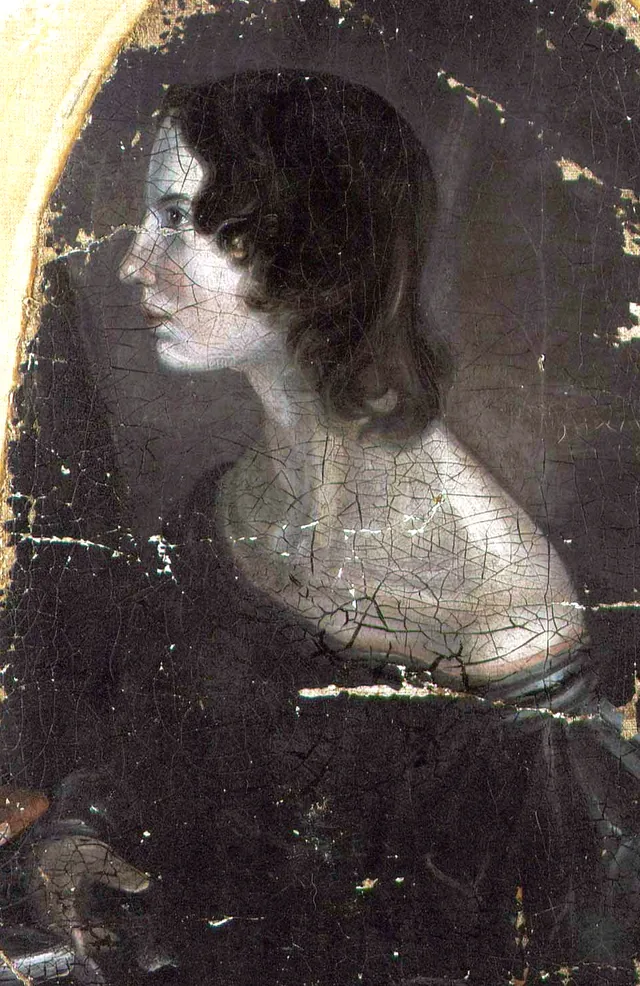


Emily Brontë
Novelist and poet · United Kingdom · 1818–1848
Birth date sourced. Birth time unknown.
The Moon remained in Cancer throughout that civil day. Everything below uses only what the complete civil day settles.The Sun stands at 6.7° Leo, in domicile — the planet in its own sign, running on home rules. Of everything the chart can be read for without a birth time, that is the loudest single fact in it.
Positions at 12:00 civil time in The Brontë Birthplace, a reference instant, not a birth time. No houses, rising sign, angles, or sect were computed.
Where the Sun actually stood
The Sun's exact place is 6.7° Leo. That falls in the first decan, 0°–10°, sub-ruled by the Sun in the classical scheme — a fire sign read through a fixed season.
The angles that hold
The tightest geometry in the chart puts Venus in the same degree of the zodiac from Mars, 0.3° off exact. Two bodies in the same degree are not read as neighbours but as a merger: whatever one wants, the other is already funding. Behind it, Saturn square Uranus at 1.0°, and Neptune square Pluto at 2.2° — both still well inside the orbs this site uses. All of it stands whatever the hour was: each angle was tested from midnight to midnight before it was written down.
The classical map
Of the seven planets the classical scheme judges, four sit in a sign it has an opinion about. The Sun in Leo at 6.7° is in domicile — the planet in its own sign, running on home rules; the Moon in Cancer at 6.6° is in domicile; Venus in Virgo at 12.1° is in fall — the tradition’s uphill placement, strength earned rather than given; Jupiter in Capricorn at 4.6° is in fall. The table describes circumstance rather than quality — a planet in detriment is inconvenienced, not diminished.
The shape of the whole
Among the 10 placements whose signs hold for the whole day, the elements divide 4 fire, 3 water, 3 earth; by modality, 6 mutable, 2 fixed, 2 cardinal. Fire signs carry the scheme’s forward pressure: heat applied early, patience treated as a later skill. No settled placement falls in air — an absence the tradition treats as information, not as a defect. Jupiter, Saturn, Uranus, Neptune and Pluto were retrograde — the backward drift a body appears to make as the Earth overtakes it, read in the scheme as a function that reviews before it releases.
The Moon, and how far it can move
The Moon stayed in Cancer for the whole of that day at the birthplace, covering 12.0° between midnight and midnight. That is quick enough to make the exact degree a neighbourhood rather than an address, and slow enough to leave the sign settled. At the noon reference it stands at 6.6°.
Where this comes fromSources, revisions, and exactly what this chart assumes
- Source article
- Emily Brontë · revision 1365227432
- Wikidata
- Q80137 · revision 2520235246
- Retrieved
- 2026-07-25T17:05:12.504Z
- Birth date
- 1818-07-30 · day precision · proleptic-gregorian
- Birthplace
- The Brontë Birthplace, United Kingdom · Q17534538
- Coordinates
- 53.7910, -1.8487 · from The Brontë Birthplace (Q17534538)
- Birth-time evidence in this profile
- none — Wikidata carries no birth-time claim for this person
- Reference instant
- 1818-07-30T12:07:24.000Z · noon civil time, not a birth time
- Omitted
- Rising sign, houses, angles, and sect. All require a birth time.
- Unknown-time range
- Moon travelled 11.96° · The Moon remained in Cancer throughout that civil day.
- Engine
- astronomy-engine (repository dependency) · @zodiacs/engine/internal/math
- Portrait
- Branwell Brontë · public domain · Wikimedia Commons
Something wrong here? Ask us to correct or remove it.