



People · sourced chart

Edward Jenner
Physician · United Kingdom · 1749–1823
Birth date sourced. Birth time unknown.The Moon remained in Gemini throughout that civil day. Everything below uses only what the complete civil day settles.
The day, read honestly
Fixed signs carry five of the ten placements whose signs are settled — the broadest certain weighting in the chart. The fixed signs hold what the cardinal signs start; a chart weighted there finishes its sentences.
Positions at 12:00 civil time in Berkeley—a reference instant, not a birth time. No houses, rising sign, angles, or sect were computed.
Where the Sun actually stood
At the noon reference the Sun sits 26.6° into Taurus — the third decan, which the old scheme hands to Saturn. Same sign, different decan, different chart.
The fast planets
Closer in, Mercury stands at 18.8° Taurus; Venus stands at 19.8° Taurus; Mars stands at 10.2° Capricorn. The tradition reads thought with its feet on the ground from Mercury, attraction that grows by reliability from Venus, effort banked steadily until it tells from Mars.
The angles that hold
Jupiter and Neptune hold the closest angle here — a trine, 0.2° wide. A trine is an open channel. The two cooperate without being asked, which is exactly why it is easy to spend and easy to take for granted. Behind it, Mercury conjunction Venus at 1.0°, and Venus square Uranus at 1.6° — both still well inside the orbs this site uses. All of it stands whatever the hour was: each angle was tested from midnight to midnight before it was written down.
What the angles build
Jupiter, Saturn, Neptune close a triangle of trines. The closed triangle is the scheme’s picture of flow — and its warning that flow, unspent, stays private. Mercury opposes Saturn while both square Uranus. The t-square is the figure the old texts trusted for output: friction with a fixed address.
The classical map
The oldest layer of the scheme — seven planets, four conditions — flags three placements in this chart. Venus in Taurus at 19.8° is in domicile — the planet in its own sign, running on home rules; Mars in Capricorn at 10.2° is in exaltation — the tradition’s honoured-guest placement, working at its best; Jupiter in Pisces at 22.9° is in domicile. The table describes circumstance rather than quality — a planet in detriment is inconvenienced, not diminished.
The shape of the whole
Of the 10 placements whose signs hold for the whole day: 4 in earth, 3 in water, 2 in air, 1 in fire by element, 5 fixed, 3 mutable, 2 cardinal by modality. Saturn and Pluto were retrograde — apparent retreat against the stars, which the old reading takes as a function working from the inside first.
The Moon, and how far it can move
The Moon stayed in Gemini for the whole of that day at the birthplace, covering 13.2° between midnight and midnight. Fast enough that its degree is approximate, slow enough that its sign is not in doubt. At the noon reference it stands at 9.3°.
Where this comes fromSources, revisions, and exactly what this chart assumes
- Source article
- Edward Jenner · revision 1365785642
- Wikidata
- Q40852 · revision 2522260287
- Retrieved
- 2026-07-26T18:47:50.947Z
- Birth date
- 1749-05-17 · day precision · proleptic-gregorian
- Birthplace
- Berkeley, United Kingdom · Q584443
- Coordinates
- 51.6910, -2.4590 · from Berkeley
- Reference instant
- 1749-05-17T12:01:15.000Z · noon civil time, not a birth time
- Omitted
- Rising sign, houses, angles, and sect—all require a birth time.
- Unknown-time range
- Moon travelled 13.16° · The Moon remained in Gemini throughout that civil day.
- Engine
- astronomy-engine (repository dependency) · @zodiacs/engine/internal/math
- Portrait
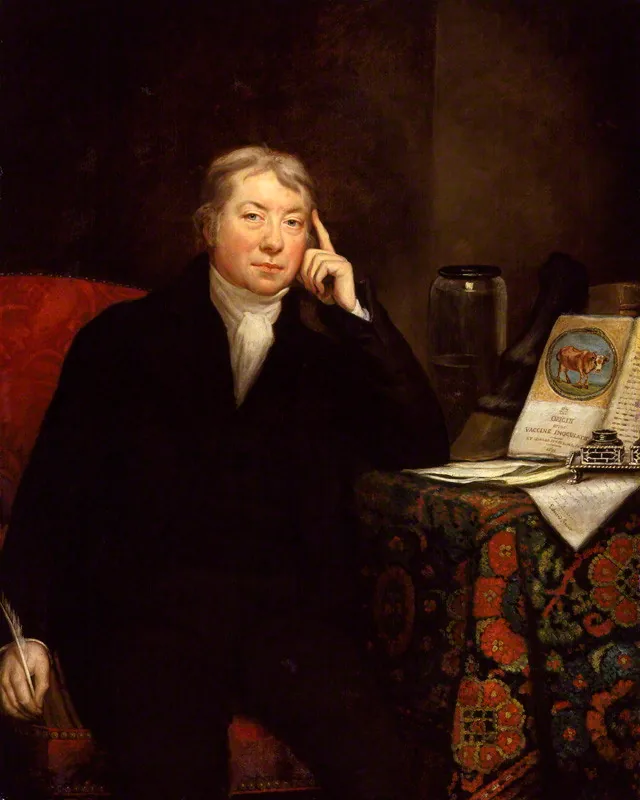
- James Northcote · public domain · Wikimedia Commons
Something wrong here?Ask us to correct or remove it.