



People · sourced chart

Dian Fossey
Anthropologist and writer · United States · 1932–1985
Birth date sourced. Birth time unknown.Moon sign undetermined. The Moon crossed from Aries into Taurus during that day. Everything below uses only what the complete civil day settles.
The day, read honestly
Four of the nine placements whose signs are settled stand in Capricorn — the Sun, Mercury, Mars and Saturn. The placements whose signs could change with an unknown hour are not counted. A cluster that size becomes the section the rest of the chart plays around.
Positions at 12:00 civil time in San Francisco—a reference instant, not a birth time. No houses, rising sign, angles, or sect were computed.
Where the Sun actually stood
At the noon reference the Sun sits 25.5° into Capricorn — the third decan, which the old scheme hands to Mercury. Same sign, different decan, different chart.
The fast planets
Day to day the chart speaks through Mercury in Capricorn (2.8°), Venus in Aquarius (27.2°), Mars in Capricorn (29.1°): thought with its feet on the ground, attraction that begins as conversation, effort banked steadily until it tells.
The angles that hold
The day's firmest angle joins the Sun and Saturn — a conjunction holding at 0.1°. The tradition stops reading a conjunction as two things. It is one appetite with two names, and it moves together or not at all. Behind it, Mars conjunction Saturn at 3.4°, and the Sun conjunction Mars at 3.6° — both still well inside the orbs this site uses. The unknown hour cannot unmake any of this: every aspect named survived all twenty-five samples of the day.
The standing structure
No closed figure — no grand trine, t-square, or grand cross — holds among the day-stable angles. The chart distributes its tension pair by pair rather than through one standing structure.
The classical map
The dignity table, which predates the outer planets and only ever spoke for seven, marks two placements here. Mars in Capricorn at 29.1° is in exaltation — the tradition’s honoured-guest placement, working at its best; Saturn in Capricorn at 25.6° is in domicile — the planet in its own sign, running on home rules. The table describes circumstance rather than quality — a planet in detriment is inconvenienced, not diminished.
The shape of the whole
Among the 9 placements whose signs hold for the whole day, the elements divide 5 earth, 2 fire, 1 air, 1 water; by modality, 6 cardinal, 2 fixed, 1 mutable. Earth weights a chart toward the material and the durable — what can be built, kept, and relied on. Jupiter, Neptune and Pluto were retrograde — apparent backward motion from where the Earth sits, which the tradition reads as a function turned inward before it is turned out.
The Moon is genuinely open
The Moon crossed from Aries into Taurus during that day at the birthplace, travelling 11.9° between one midnight and the next. Half the day belongs to each sign, and the split falls at an unrecorded hour — so this page holds the Moon as a genuine unknown.
Where this comes fromSources, revisions, and exactly what this chart assumes
- Source article
- Dian Fossey · revision 1365747872
- Wikidata
- Q234224 · revision 2517545373
- Retrieved
- 2026-07-26T18:47:50.947Z
- Birth date
- 1932-01-16 · day precision · proleptic-gregorian
- Birthplace
- San Francisco, United States · Q62
- Coordinates
- 37.7750, -122.4194 · from San Francisco
- Reference instant
- 1932-01-16T20:00:00.000Z · noon civil time, not a birth time
- Omitted
- Rising sign, houses, angles, and sect—all require a birth time.
- Unknown-time range
- Moon travelled 11.90° · Moon sign undetermined. The Moon crossed from Aries into Taurus during that day.
- Engine
- astronomy-engine (repository dependency) · @zodiacs/engine/internal/math
- Portrait
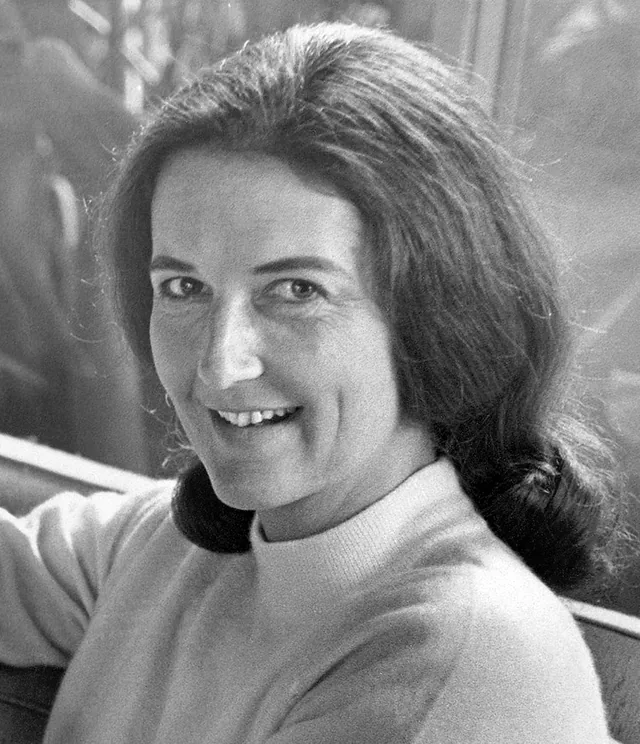
- Tribune Publishing, no photographer credited · public domain · Wikimedia Commons
Something wrong here?Ask us to correct or remove it.