



People · sourced chart

Colette
Novelist and actor · France · 1873–1954
Birth date sourced. Birth time unknown.Moon sign undetermined. The Moon crossed from Capricorn into Aquarius during that day. Everything below uses only what the complete civil day settles.
The day, read honestly
Tightest of all, Mercury holds a sextile to Venus at 0.9° — close enough to weld thinking to taste. Sextiles are read as standing invitations — productive exactly as often as they are accepted.
Positions at 12:00 civil time in Saint-Sauveur-en-Puisaye—a reference instant, not a birth time. No houses, rising sign, angles, or sect were computed.
Where the Sun actually stood
8.7° of Aquarius is the Sun's exact seat — first decan, 0°–10°, sub-ruled by Saturn in the old triplicity scheme. The degree is the address; the sign is only the street.
The fast planets
Day to day the chart speaks through Mercury in Capricorn (22.6°), Venus in Pisces (23.5°), Mars in Scorpio (2.5°): thought with its feet on the ground, attraction that works by atmosphere, effort that surges when it matters.
The angles that hold
The tightest geometry in the chart puts Mercury a sixth of the circle apart from Venus, 0.9° off exact. A sextile pays out only on effort; the scheme calls it opportunity rather than gift. Behind it, Mercury square Neptune at 1.1°, and Mars square Uranus at 1.1° — both still well inside the orbs this site uses. The unknown hour cannot unmake any of this: every aspect named survived all twenty-five samples of the day.
The standing structure
The Sun opposes Uranus while both square Mars. A t-square aims the whole axis at its apex planet; the tradition reads it as the chart’s standing assignment.
The classical map
The oldest layer of the scheme — seven planets, four conditions — flags four placements in this chart. The Sun in Aquarius at 8.7° is in detriment — the planet opposite its home, working against the grain; Venus in Pisces at 23.5° is in exaltation — the tradition’s honoured-guest placement, working at its best; Mars in Scorpio at 2.5° is in domicile — the planet in its own sign, running on home rules; Saturn in Capricorn at 25.4° is in domicile. The table describes circumstance rather than quality — a planet in detriment is inconvenienced, not diminished.
The shape of the whole
The honest balance sheet uses the 9 placements whose signs hold for the whole day: earth 3, fire 3, water 2, air 1 across the elements, and fixed 5, cardinal 3, mutable 1 across the modalities. Earth weights a chart toward the material and the durable — what can be built, kept, and relied on. Jupiter, Uranus and Pluto were retrograde — apparent backward motion from where the Earth sits, which the tradition reads as a function turned inward before it is turned out.
The Moon is genuinely open
The Moon crossed from Capricorn into Aquarius during that day at the birthplace, travelling 15.3° between one midnight and the next. A birth time would settle it in a second; there isn’t one. So the Moon stays unnamed here — the alternative is a guess wearing the clothes of a fact.
Where this comes fromSources, revisions, and exactly what this chart assumes
- Source article
- Colette · revision 1361423917
- Wikidata
- Q218679 · revision 2522904669
- Retrieved
- 2026-07-26T18:47:50.947Z
- Birth date
- 1873-01-28 · day precision · proleptic-gregorian
- Birthplace
- Saint-Sauveur-en-Puisaye, France · Q1141101
- Coordinates
- 47.6183, 3.1972 · from Saint-Sauveur-en-Puisaye
- Reference instant
- 1873-01-28T11:50:39.000Z · noon civil time, not a birth time
- Omitted
- Rising sign, houses, angles, and sect—all require a birth time.
- Unknown-time range
- Moon travelled 15.30° · Moon sign undetermined. The Moon crossed from Capricorn into Aquarius during that day.
- Engine
- astronomy-engine (repository dependency) · @zodiacs/engine/internal/math
- Portrait
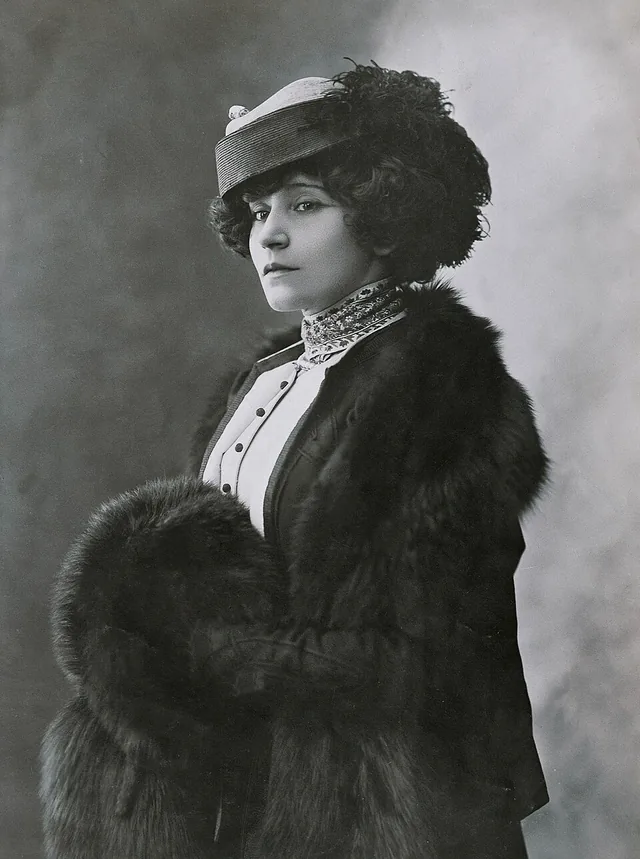
- Henri Manuel · public domain · Wikimedia Commons
Something wrong here?Ask us to correct or remove it.