



People · sourced chart

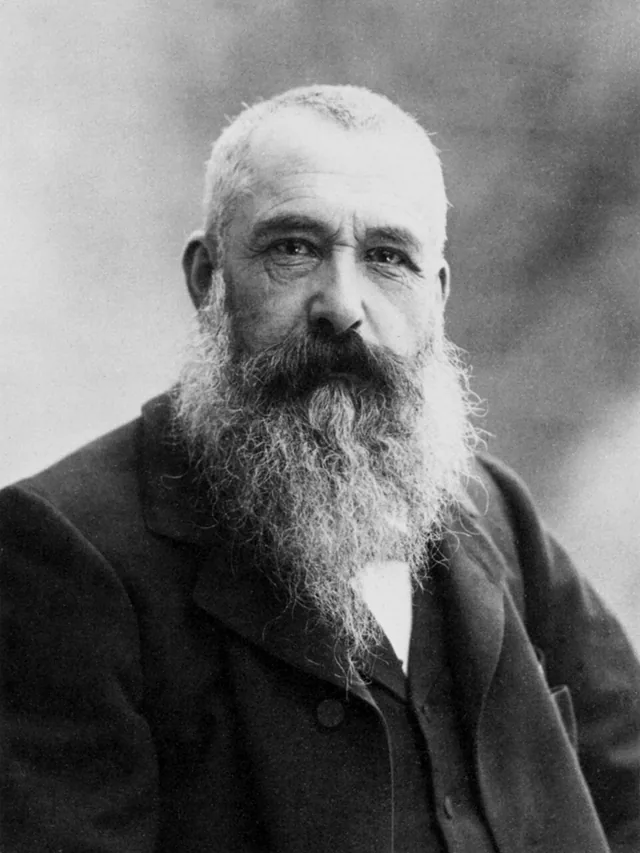
Claude Monet
Painter · France · 1840–1926
Birth date sourced. Birth time unknown.Moon sign undetermined. The Moon crossed from Cancer into Leo during that day. Everything below uses only what the complete civil day settles.
The day, read honestly
0.1° separates Mars and Saturn from an exact square; at that range drive and structure read as one mechanism. Right angles are where the scheme puts its grit. A square asks two functions to work in a mode neither would have chosen.
Positions at 12:00 civil time in Paris—a reference instant, not a birth time. No houses, rising sign, angles, or sect were computed.
Where the Sun actually stood
At noon on that date the Sun stood at 22.2° Scorpio, inside the third decan (20°–30°), whose traditional sub-ruler is the Moon. The decan is the older, finer division — it is what the sign looks like once you stop rounding it to thirty degrees.
Closer to the ground
For the fast movers, Mercury was at 14.6° Sagittarius, Venus was at 21.2° Sagittarius, Mars was at 20.4° Virgo. Read together: thought that arrives already in motion; attraction declared rather than implied; effort banked steadily until it tells.
The angles that hold
Start where the chart is tightest — Mars square Saturn, 0.1° of separation. Right angles are where the scheme puts its grit. A square asks two functions to work in a mode neither would have chosen. Behind it, Venus conjunction Saturn at 0.7°, and Venus square Mars at 0.8° — both still well inside the orbs this site uses. The unknown hour cannot unmake any of this: every aspect named survived all twenty-five samples of the day.
Figures in the geometry
Mars opposes Uranus while both square Mercury. Two squares braced against one opposition make a t-square — the chart’s working end, where pressure keeps finding the same outlet.
The classical map
The oldest layer of the scheme — seven planets, four conditions — flags a single placement in this chart. Mercury in Sagittarius at 14.6° is in detriment — the planet opposite its home, working against the grain. None of this ranks anyone; dignity describes footing, and footing can be worked with.
The shape of the whole
The certain ground: 9 placements whose signs hold for the whole day, dividing 4 fire, 3 water, 1 earth, 1 air by element and 5 mutable, 3 fixed, 1 cardinal by mode. A fire emphasis is read as appetite for the first move, with information gathered by doing rather than before doing. Uranus and Pluto were retrograde — apparent backward motion from where the Earth sits, which the tradition reads as a function turned inward before it is turned out.
The Moon is genuinely open
The Moon crossed from Cancer into Leo during that day at the birthplace, travelling 14.3° between one midnight and the next. A birth time would settle it in a second; there isn’t one. So the Moon stays unnamed here — the alternative is a guess wearing the clothes of a fact.
Where this comes fromSources, revisions, and exactly what this chart assumes
- Source article
- Claude Monet · revision 1364953615
- Wikidata
- Q296 · revision 2522905876
- Retrieved
- 2026-07-26T18:47:50.947Z
- Birth date
- 1840-11-14 · day precision · proleptic-gregorian
- Birthplace
- Paris, France · Q90
- Coordinates
- 48.8567, 2.3522 · from Paris
- Reference instant
- 1840-11-14T11:50:39.000Z · noon civil time, not a birth time
- Omitted
- Rising sign, houses, angles, and sect—all require a birth time.
- Unknown-time range
- Moon travelled 14.28° · Moon sign undetermined. The Moon crossed from Cancer into Leo during that day.
- Engine
- astronomy-engine (repository dependency) · @zodiacs/engine/internal/math
- Portrait
- Nadar · public domain · Wikimedia Commons
Something wrong here?Ask us to correct or remove it.