



People · sourced chart

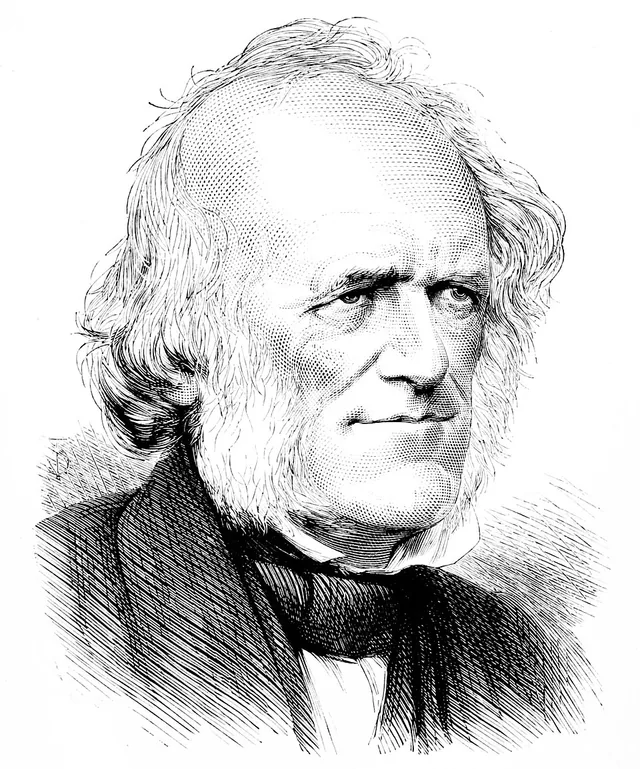
Charles Lyell
Geologist and lawyer · United Kingdom · 1797–1875
Birth date sourced. Birth time unknown.Moon sign undetermined. The Moon crossed from Virgo into Libra during that day. Everything below uses only what the complete civil day settles.
The day, read honestly
The chart's headline is a conjunction: Mercury and Neptune within 0.1°, thinking wired to imagination. A conjunction concentrates rather than balances — the pair burns one fuel line.
Positions at 12:00 civil time in Angus—a reference instant, not a birth time. No houses, rising sign, angles, or sect were computed.
Where the Sun actually stood
Measured rather than labelled, the Sun holds 22.7° Scorpio: the third decan, whose classical sub-ruler is the Moon. A water sign, read here in its third face.
Closer to the ground
For the fast movers, Mercury was at 10.8° Scorpio, Venus was at 4.5° Capricorn, Mars was at 19.3° Libra. Read together: a mind that absorbs before it argues; taste for the substantial and the lasting; drive that argues its way forward.
The angles that hold
Mercury to Neptune is the closest call of the day, a conjunction within 0.1°. A conjunction is the least negotiable aspect in the scheme — no distance to argue across, so the pair arrives as a single instinct. Behind it, Saturn trine Neptune at 0.8°, and Mercury trine Saturn at 0.8° — both still well inside the orbs this site uses. Each angle here was measured at every hour of the civil day and held; whatever the missing clock said, this geometry was in it.
Figures in the geometry
Venus opposes Saturn while both square Jupiter. A t-square aims the whole axis at its apex planet; the tradition reads it as the chart’s standing assignment. The Moon stands apart from every major angle the day held — the tradition reads an unaspected planet as a voice that speaks on its own schedule, unmodulated by the rest of the chart.
The classical map
Two planets here sit in a sign the classical scheme scores. Mars in Libra at 19.3° is in detriment — the planet opposite its home, working against the grain; Saturn in Cancer at 11.7° is in detriment. Condition, not character: that is all the dignity table ever measured.
The shape of the whole
Among the 9 placements whose signs hold for the whole day, the elements divide 4 water, 2 earth, 2 air, 1 fire; by modality, 4 fixed, 4 cardinal, 1 mutable. Water reads the room before the room speaks — atmosphere first, analysis later. Jupiter and Saturn were retrograde — apparent backward motion from where the Earth sits, which the tradition reads as a function turned inward before it is turned out.
The Moon is genuinely open
The Moon crossed from Virgo into Libra during that day at the birthplace, travelling 14.0° between one midnight and the next. Without a recorded hour there is no honest way to say which side it was on, so this reading does not say. The Moon sign is a real question here, not a rounding error, and it needs a birth time nobody has published.
Where this comes fromSources, revisions, and exactly what this chart assumes
- Source article
- Charles Lyell · revision 1365087342
- Wikidata
- Q5333 · revision 2519822724
- Retrieved
- 2026-07-26T18:47:50.947Z
- Birth date
- 1797-11-14 · day precision · proleptic-gregorian
- Birthplace
- Angus, United Kingdom · Q202177
- Coordinates
- 56.6667, -2.9167 · from Angus
- Reference instant
- 1797-11-14T12:01:15.000Z · noon civil time, not a birth time
- Omitted
- Rising sign, houses, angles, and sect—all require a birth time.
- Unknown-time range
- Moon travelled 14.04° · Moon sign undetermined. The Moon crossed from Virgo into Libra during that day.
- Engine
- astronomy-engine (repository dependency) · @zodiacs/engine/internal/math
- Portrait
- Unknown author · public domain · Wikimedia Commons
Something wrong here?Ask us to correct or remove it.