



People · sourced chart

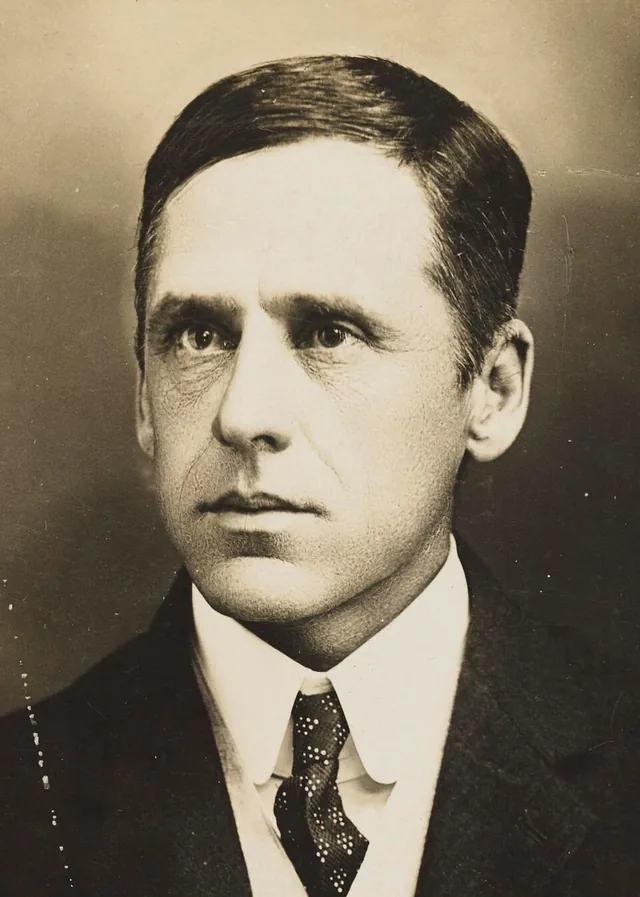
Banjo Paterson
Poet and lawyer · Australia · 1864–1941
Birth date sourced. Birth time unknown.Moon sign undetermined. The Moon crossed from Gemini into Cancer during that day. Everything below uses only what the complete civil day settles.
The day, read honestly
Four of the nine placements whose signs are settled fall in fixed signs, the widest weighting the unknown hour leaves certain. Fixed weight is read as endurance, with the same machinery producing both loyalty and stubbornness.
Positions at 12:00 civil time in Orange—a reference instant, not a birth time. No houses, rising sign, angles, or sect were computed.
Where the Sun actually stood
The Sun's exact place is 27.7° Aquarius. That falls in the third decan, 20°–30°, sub-ruled by Venus in the classical scheme — a air sign read through a fixed season.
The fast planets
Closer in, Mercury stands at 1.3° Aquarius; Venus stands at 19.8° Capricorn; Mars stands at 14.7° Capricorn. The tradition reads a mind at home in argument and pattern from Mercury, taste for the substantial and the lasting from Venus, drive that grinds rather than flares from Mars.
The angles that hold
The Sun and Jupiter hold the closest angle here — a square, 1.1° wide. A square is the tradition’s engine room: two drives at cross purposes, and the friction is the horsepower. Behind it, Venus square Saturn at 2.1°, and Mars square Saturn at 3.0° — both still well inside the orbs this site uses. These angles were checked through every hour of that civil day and survive throughout, which is why an unrecorded hour does not disturb them.
Figures in the geometry
The day-stable angles form no closed figure. Nothing funnels; each aspect is its own negotiation, which the tradition reads as a chart of separate treaties rather than one campaign.
The classical map
Three planets here sit in a sign the classical scheme scores. The Sun in Aquarius at 27.7° is in detriment — the planet opposite its home, working against the grain; Mars in Capricorn at 14.7° is in exaltation — the tradition’s honoured-guest placement, working at its best; Saturn in Libra at 17.7° is in exaltation. The old table grades terrain, not talent — a placement in fall works uphill, nothing more.
The shape of the whole
Counting only the 9 placements whose signs hold for the whole day, the chart runs 4 air, 3 earth, 1 water, 1 fire by element and 4 fixed, 4 cardinal, 1 mutable by modality. Air runs on comparison and connection — the pattern noticed first, the feeling filed second. Saturn and Uranus were retrograde — apparent backward motion from where the Earth sits, which the tradition reads as a function turned inward before it is turned out.
The Moon is genuinely open
The Moon crossed from Gemini into Cancer during that day at the birthplace, travelling 12.1° between one midnight and the next. The hour would decide it; no hour was recorded. The reading keeps the question open rather than flipping a coin dressed as astrology.
Where this comes fromSources, revisions, and exactly what this chart assumes
- Source article
- Banjo Paterson · revision 1361882733
- Wikidata
- Q436699 · revision 2517355805
- Retrieved
- 2026-07-26T18:47:50.947Z
- Birth date
- 1864-02-17 · day precision · proleptic-gregorian
- Birthplace
- Orange, Australia · Q580973
- Coordinates
- -33.2817, 149.1011 · from Orange
- Reference instant
- 1864-02-17T01:55:08.000Z · noon civil time, not a birth time
- Omitted
- Rising sign, houses, angles, and sect—all require a birth time.
- Unknown-time range
- Moon travelled 12.08° · Moon sign undetermined. The Moon crossed from Gemini into Cancer during that day.
- Engine
- astronomy-engine (repository dependency) · @zodiacs/engine/internal/math
- Portrait
- Falk Studio · public domain · Wikimedia Commons
Something wrong here?Ask us to correct or remove it.